Acessório · Neckwear
Scarves
A scarf is best in cashmere for light warmth, wool for durability or silk for evening and wind, and its width decides whether it knots or drapes.
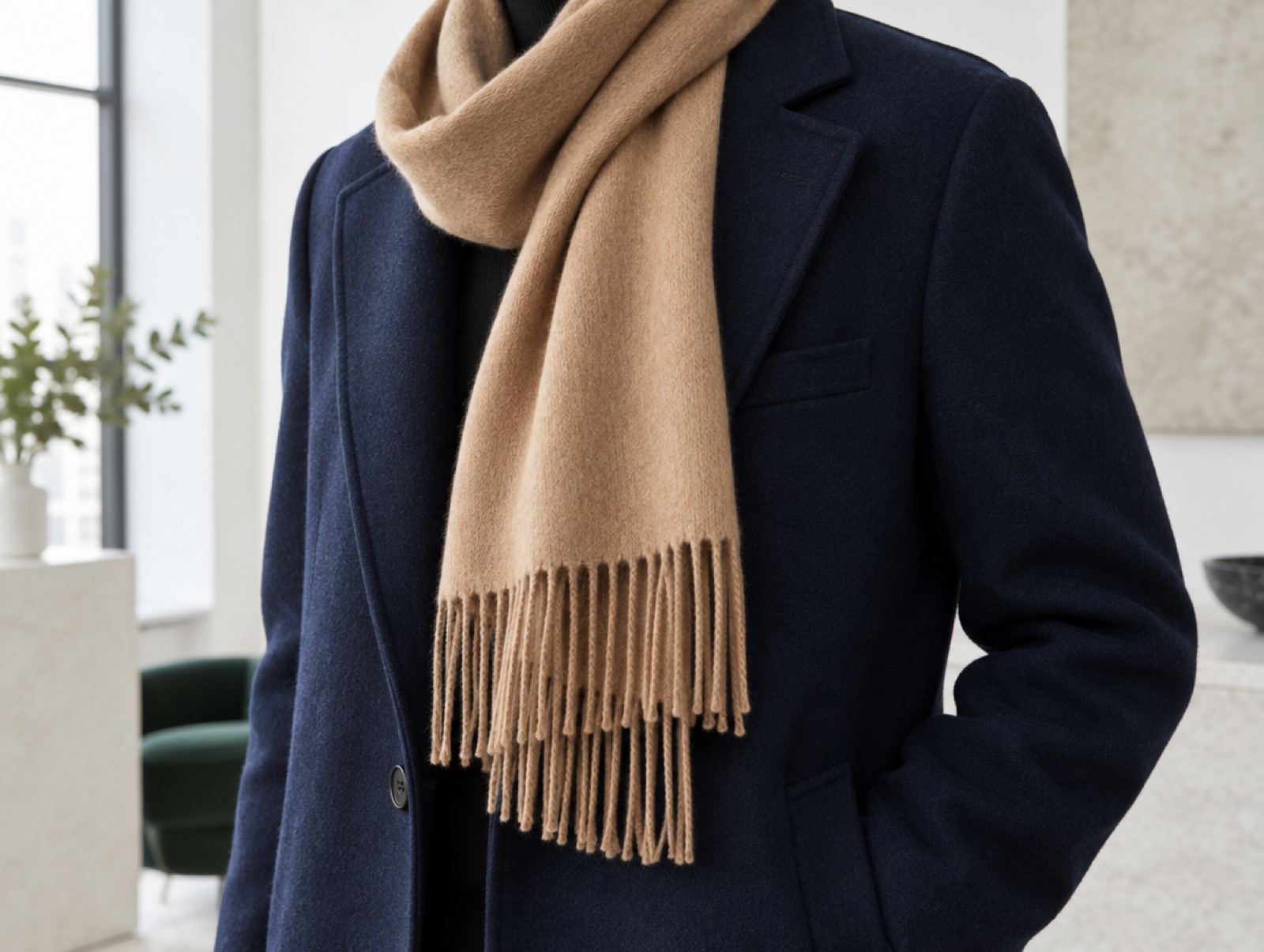
A scarf is judged on fibre and on weave. Cashmere is warm and light; wool is more durable; silk is for evening and for wind rather than cold. Width and length determine how it can be worn: a long narrow scarf knots, a wide one drapes.
Fibre and weave
Because a scarf is small, it is the cheapest way to own something in a genuinely fine fibre, and because it is worn against the neck, where skin is sensitive, fineness is actually useful rather than merely luxurious.
The weave matters as much: a loosely woven or knitted scarf traps more air and is warmer for its weight than a densely woven one of the same fibre. A tightly woven silk scarf blocks wind but does not insulate.
Size and how it is worn
A long narrow scarf, roughly 180 by 30 centimetres, knots and tucks into a coat collar. A wider one drapes over the shoulders and does not knot cleanly. Both are useful; they do different things.
The simplest arrangement is folded in half, placed around the neck and the ends passed through the loop, which stays put under a coat. Anything more elaborate tends to come undone.
Evening
A white silk scarf with evening dress is a genuine convention rather than a costume flourish: it protects the shirt front and the collar from the coat, which is what silk is for here. It is also the one place in menswear where an obviously decorative accessory is entirely orthodox, which is presumably why it survived.
Em síntese
Créditos fotográficos 1
- A cashmere scarf on an overcoat collar: Original art · Il Sartoriale · Il Sartoriale · Il Sartoriale original art