Accessory · Small Leather
The umbrella
A traditional umbrella built on a single solid stick can last for decades, while a folding umbrella is easier to carry but tends to break at the joints.
A traditional umbrella is built on a single continuous shaft, a solid stick, with a wooden or metal frame and a canopy of tightly woven nylon or, historically, silk. Folding umbrellas trade all of that for portability and fail at the joints.
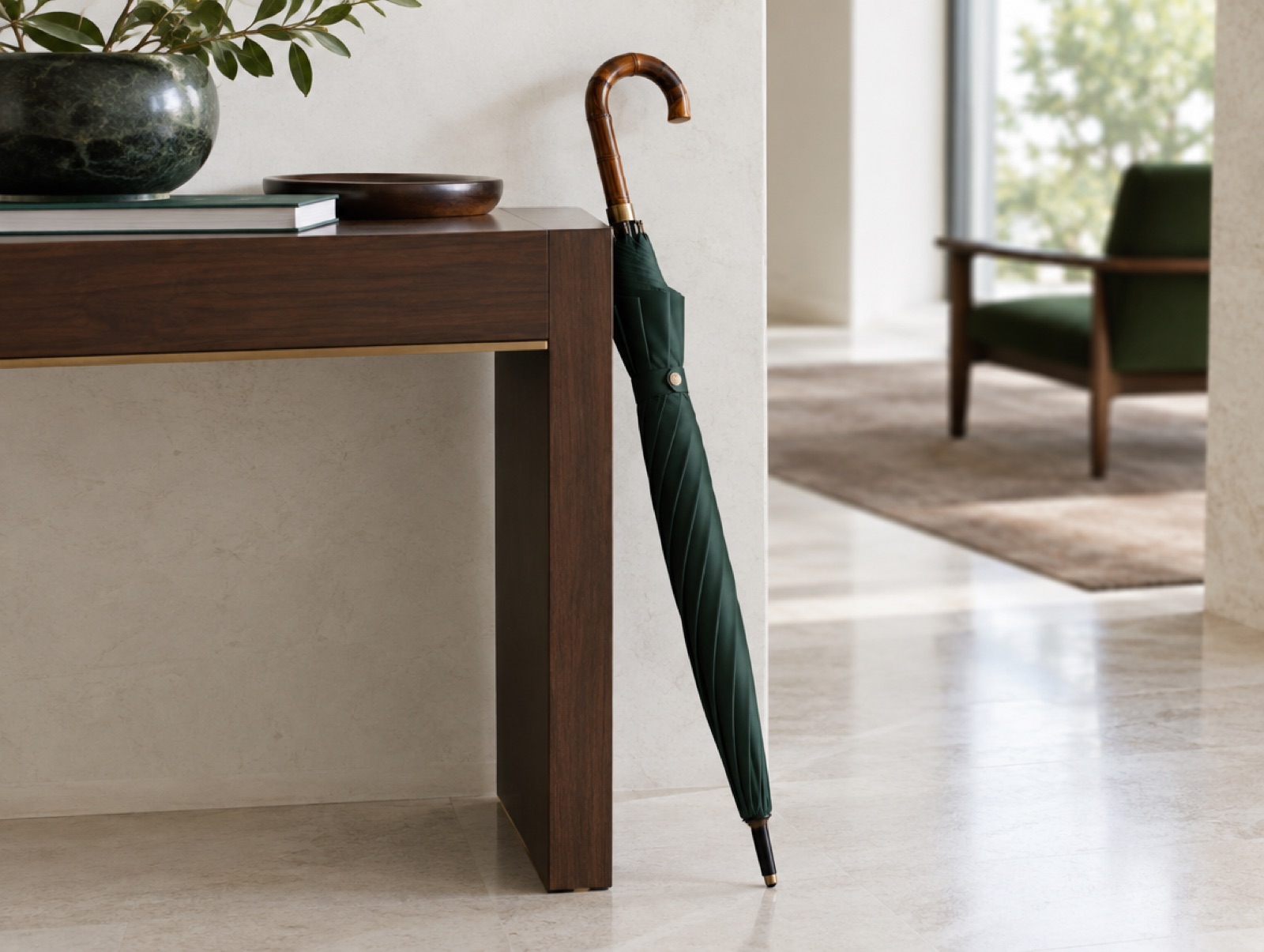
Solid stick
One continuous shaft from handle to tip, with no telescoping joints, means nothing to fail and enough rigidity to lean on. The best examples are built around a single piece of wood (chestnut, maple, ash) with the handle formed from the same length by steaming and bending it.
The canopy on a good umbrella is tightly woven and cut so the ribs tension it evenly; a cheap one bags between ribs and channels water onto the wearer.
Care
Dry it open, or nearly open, rather than rolled: a rolled wet umbrella rots at the folds and rusts at the ribs. Do not force a solid-stick umbrella closed while the fabric is stretched by wind.
The tie should be wrapped, not knotted, and a properly cut canopy will roll down slim without being forced.
Frames and canopies
Traditional frames are steel with a whalebone-substitute rib; better modern ones use fibreglass or carbon, which flexes without taking a set in wind. The canopy should be cut so the fabric is under even tension at each rib, with no bagging between them.
A well-made umbrella can be re-covered when the canopy fails, which is what turns it from a consumable into an object. Very few people know this and almost nobody does it.
At a glance
Picture credits 1
- A solid-stick umbrella with a cane handle: Original art · Il Sartoriale · Il Sartoriale · Il Sartoriale original art