Comparison
Goodyear welting vs hand welting
The same idea executed two ways: a glued canvas rib and a machine, or a ridge carved from the insole and a needle. One is affordable; the other has nothing that can fail.
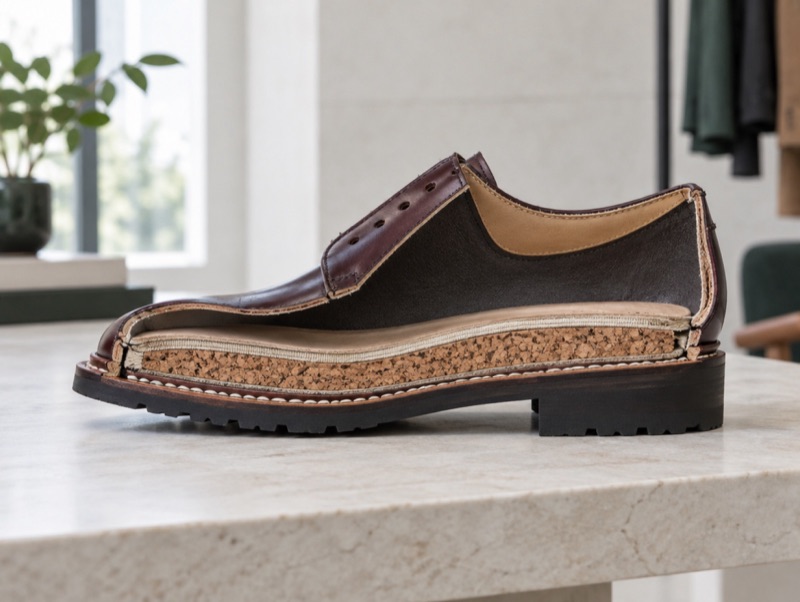
Goodyear welting
Goodyear welting is the durable machine-stitched construction used on good English and American shoes, letting a worn sole be replaced without touching the top.
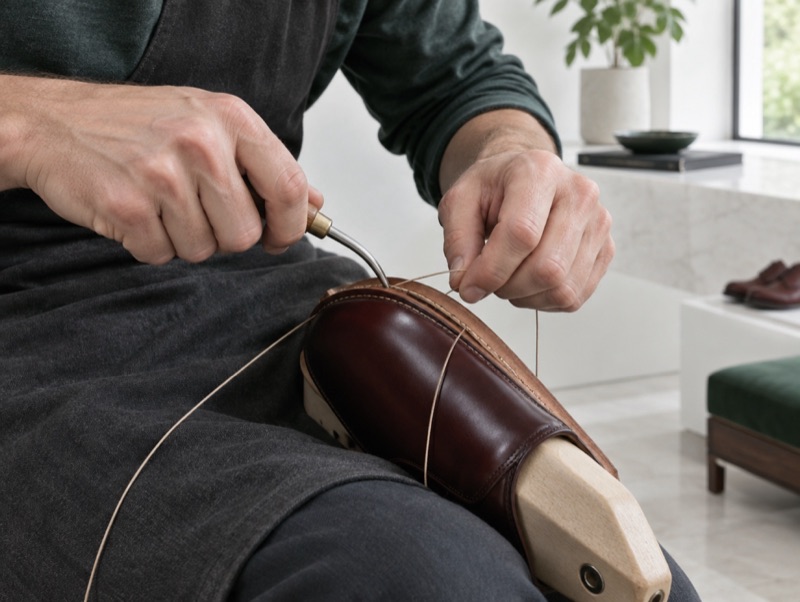
Hand welting
The shoemaking equivalent of a hand-padded canvas: slow, invisible, and the basis of everything above it.
The single structural difference
In hand welting the maker carves a holdfast, a vertical ridge, from the insole leather itself and stitches the welt to it. In Goodyear welting a canvas rib is glued to a flat insole and the welt is stitched to that.
Everything else follows. The carved holdfast is part of the insole and cannot separate; the glued rib is an addition and eventually can. That is the whole engineering distinction between the two.
What it means in wear
A hand-welted shoe can have a thinner, closer waist, because there is no rib and less cork filling taking up room under the arch. It flexes closer to where the foot flexes. And it can be resoled as many times as the upper survives.
A Goodyear-welted shoe is bulkier under the foot when new, takes longer to break in, and can generally be resoled several times before the gemming becomes a problem. For most wearers that is more resolings than they will ever need.
Cost and availability
Hand welting is measured in hours per pair and is found almost exclusively in bespoke and in a small number of made-to-order makers. Goodyear welting is machine work and is the basis of the entire good-shoe market, Northampton, Spain, parts of Italy and eastern Europe.
The honest position is that Goodyear welting is one of the more successful pieces of industrial engineering in clothing: it made a repairable shoe affordable, which is why an expensive pair is an investment rather than an extravagance.
Side by side
| Goodyear welting | Hand welting | |
|---|---|---|
| Insole | Flat, with a glued canvas rib | Holdfast carved from the leather |
| Executed by | Machine | Hand, with an awl and waxed thread |
| Waist | Thicker: rib and filling | Thinner, can be sculpted close |
| Resoleable | Several times | As many times as the upper survives |
| Weak point | The gemming, eventually | None structural |
| Where found | Northampton, Spain, Italy: the good-shoe market | Bespoke and a few made-to-order makers |
| Price | From a few hundred | Thousands |
What each is better at
This section is editorial opinion, clearly separated from the record above. It follows our stated assessment method.
Other comparisons
All →Picture credits 2
- A welted shoe cut in cross-section: Original art · Il Sartoriale · Il Sartoriale · Il Sartoriale original art
- Hand-stitching a welt to an insole: Original art · Il Sartoriale · Il Sartoriale · Il Sartoriale original art