Vêtement · Tailoring
The morning coat
The morning coat is formal daytime wear with a front that curves away to one long tail, still worn at weddings and racecourses.
Morning dress is the formal daytime equivalent of white tie: a morning coat cut with the front sloping away from a single button to a long back skirt, worn with striped or checked trousers, a waistcoat, and a formal shirt and tie. It survives at weddings, racecourses and a few ceremonial occasions.
The cut
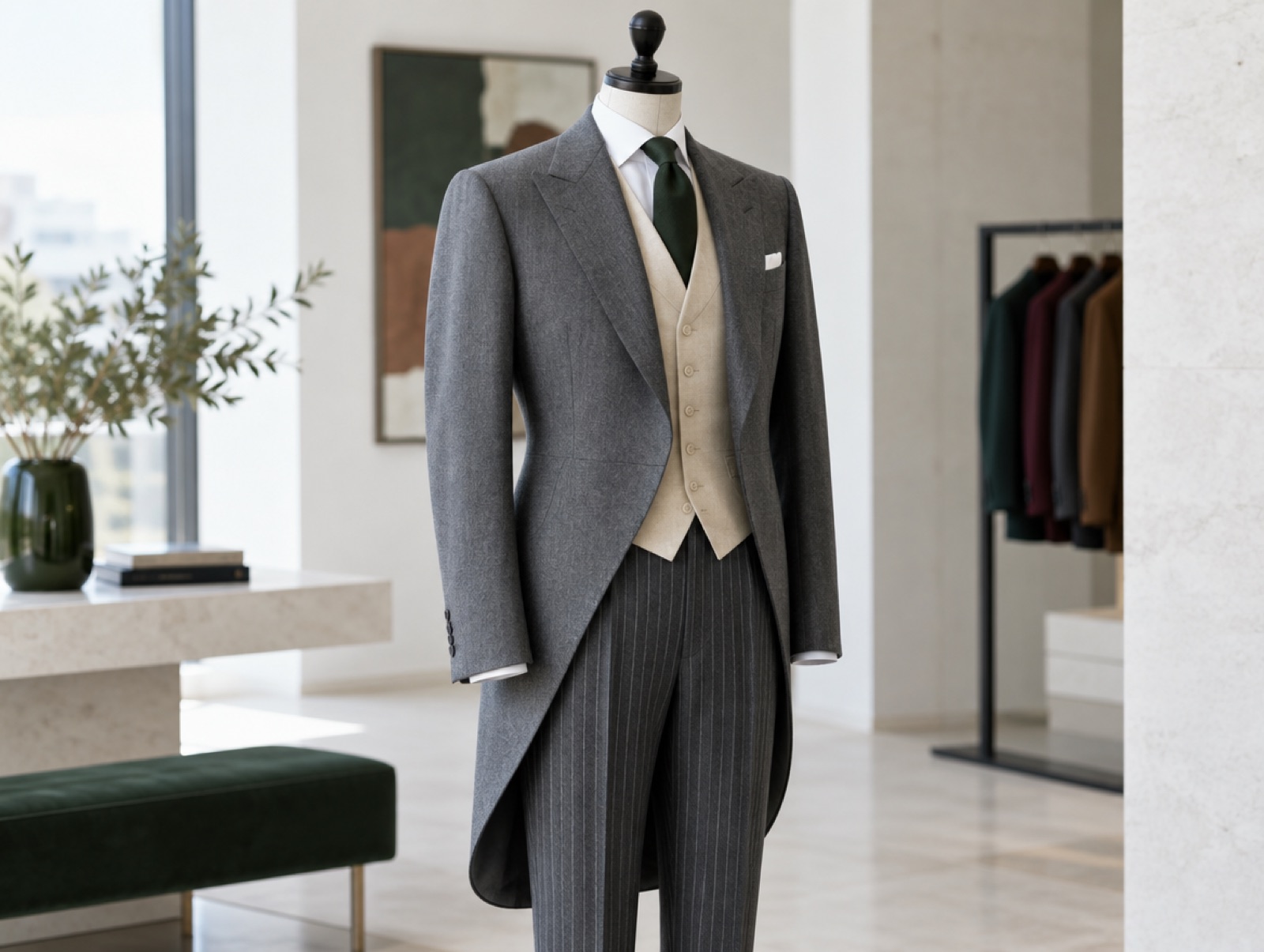
The distinguishing feature is the curved front, sloping back from a single fastening button to a skirt that falls to about the back of the knee. It descends from riding dress (the front was cut away so the coat did not sit under the rider), which is why it is sometimes called a cutaway.
Trousers are traditionally a contrasting cloth: grey and black stripe, or a check. The waistcoat may match the coat or contrast, buff and dove grey being the conventional options.
The conventions
Grey or black coat; contrasting trousers, traditionally grey and black stripe or a check; a waistcoat in buff, dove grey or matching the coat; a turndown collar shirt and a tie or cravat; black oxfords.
A top hat is correct at Ascot and at weddings where the party is wearing them, and looks eccentric otherwise. Morning dress is worn before six in the evening; after that it is white tie.
Hiring or owning
Most men wear morning dress at somebody else's wedding two or three times in a life, and hiring is entirely reasonable. The two things worth doing regardless are having the trousers taken up to the right length and wearing your own shirt, because a hired shirt collar will not fit and it is the part people see.
For anyone who will wear it more than a handful of times, the coat is the piece to own; trousers and waistcoat can be hired around it.
En un coup d'œil
Crédits photographiques 1
- A morning coat with its curved front: Original art · Il Sartoriale · Il Sartoriale · Il Sartoriale original art