Guide · Guides
How to tell a well-made jacket in ninety seconds
Six shop checks, such as buttonholes, lining, shoulder and whether patterns line up at seams, reveal how well a jacket was made.
Most of what makes a jacket good is invisible, but not all of it. The chest construction, the lapel roll, the buttonholes, the pattern matching, the lining and the shoulder can all be assessed quickly, and together they give a reliable read on how the garment was made.
The checks
- Pinch the front panel below the buttonhole, away from the pocket. A third loose layer between cloth and lining means a floating canvas. A single stiff board means fusing. Do it low as well as at the chest, a half-canvassed jacket passes high and fails low.
- Look at the lapel roll. A soft three-dimensional curve means a shaped canvas; a sharp pressed crease at the fold usually means there is not one.
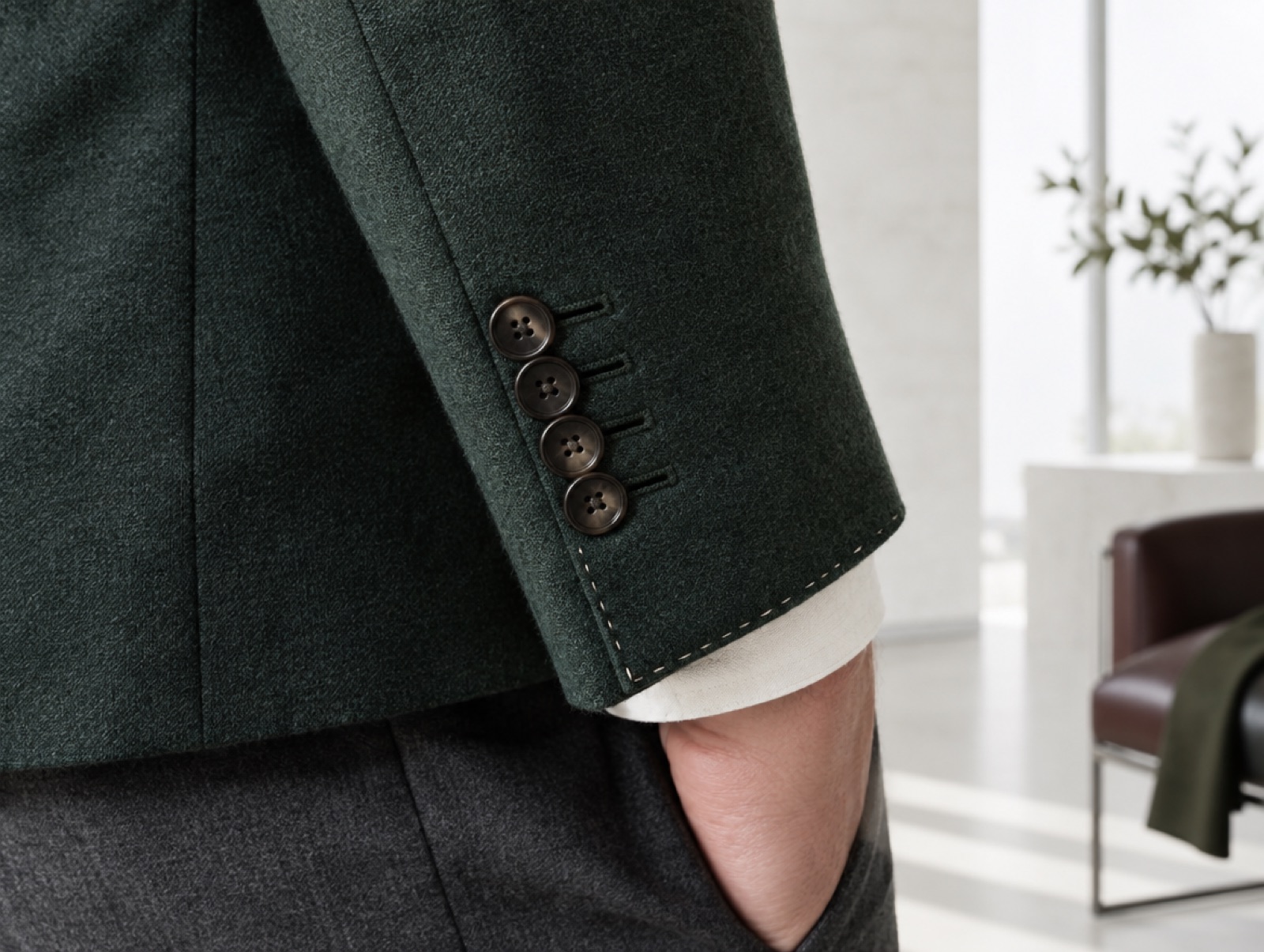
- Examine a buttonhole. Slight irregularity in stitch length means hand-worked. Perfect uniformity means machine, which tells you about the buttonhole, not the whole coat.
- Check the pattern across the patch pockets and the centre back seam. A well-matched patch pocket disappears into the cloth behind it.
- Look at the shoulder on your own body. The seam should end where your shoulder ends. This is the only check that cannot be fixed afterwards.
- Turn back the lining at the hem or the vent if you can, and look at how the internal seams are finished.
What these checks cannot tell you
How well it was cut, which matters more than any of them. A poorly cut fully canvassed jacket is a worse garment than a well-cut half-canvassed one, and construction is a tiebreaker between garments that both fit rather than a substitute for fit.
They also cannot tell you where it was made, who made it, or whether the price is reasonable. Those are questions to ask, and a shop that answers them precisely is telling you something.
At a glance
Picture credits 1
- A cuff with working buttonholes: Original art · Il Sartoriale · Il Sartoriale · Il Sartoriale original art