역사 · History
How Naples took the weight out of the jacket
Neapolitan tailoring began in 1930s Naples, where workshops like Rubinacci removed the padding, stiffening and lining from English jackets so they felt light in the heat.
Neapolitan tailoring emerged in the 1930s when local workshops, the Rubinacci London House most visibly, began stripping the canvas, padding and lining out of the English coat to make it wearable in southern heat. It stayed a local style for fifty years and became the most copied in the world in about twenty-five.
The English problem
Naples in the early twentieth century dressed in the English manner, because everywhere did. An English coat is built around a horsehair canvas with a padded shoulder and a full lining, in cloth heavy enough to take a press: a garment designed for a cold, wet island.
In a Neapolitan summer it is close to unwearable, and the local trade's response was to remove weight wherever it could be removed without losing shape.
London House
Gennaro Rubinacci opened London House in 1932; the name signals what the shop originally sold. Its cutter, Vincenzo Attolini, is the figure conventionally credited with the transformation: thinning the chest canvas to almost nothing, removing the shoulder padding, cutting the lining back, and setting the sleeve into a high small armhole with the fullness gathered at the head.
Whether one man invented it is a fair question. The trade was moving that way and other workshops were experimenting. What is documented is that this workshop is where the change is first clearly recorded, and that the line from it to the present is unbroken.
Fifty years of being local
For most of the twentieth century this was a regional style with no international profile. Naples was not a wealthy city, its tailors competed on making customers look well in cloth they could afford, and softness was a solution to a problem rather than an aesthetic position.
What changed from the 1990s was the world, not Naples. As business dress relaxed everywhere, the international market discovered it wanted precisely the jacket Naples had been making for sixty years: light, soft, wearable without a tie.
The consequence
Neapolitan construction is now imitated globally, including by factories producing fused jackets with machine-gathered shoulders sold as Neapolitan. The signatures have become a visual language detachable from the construction that produced them.
Within Naples the effect has been mixed: a great deal more work, considerably more scrutiny, and a generational question about whether enough young tailors are being trained to sustain it.
한눈에 보기
사진 크레딧 1
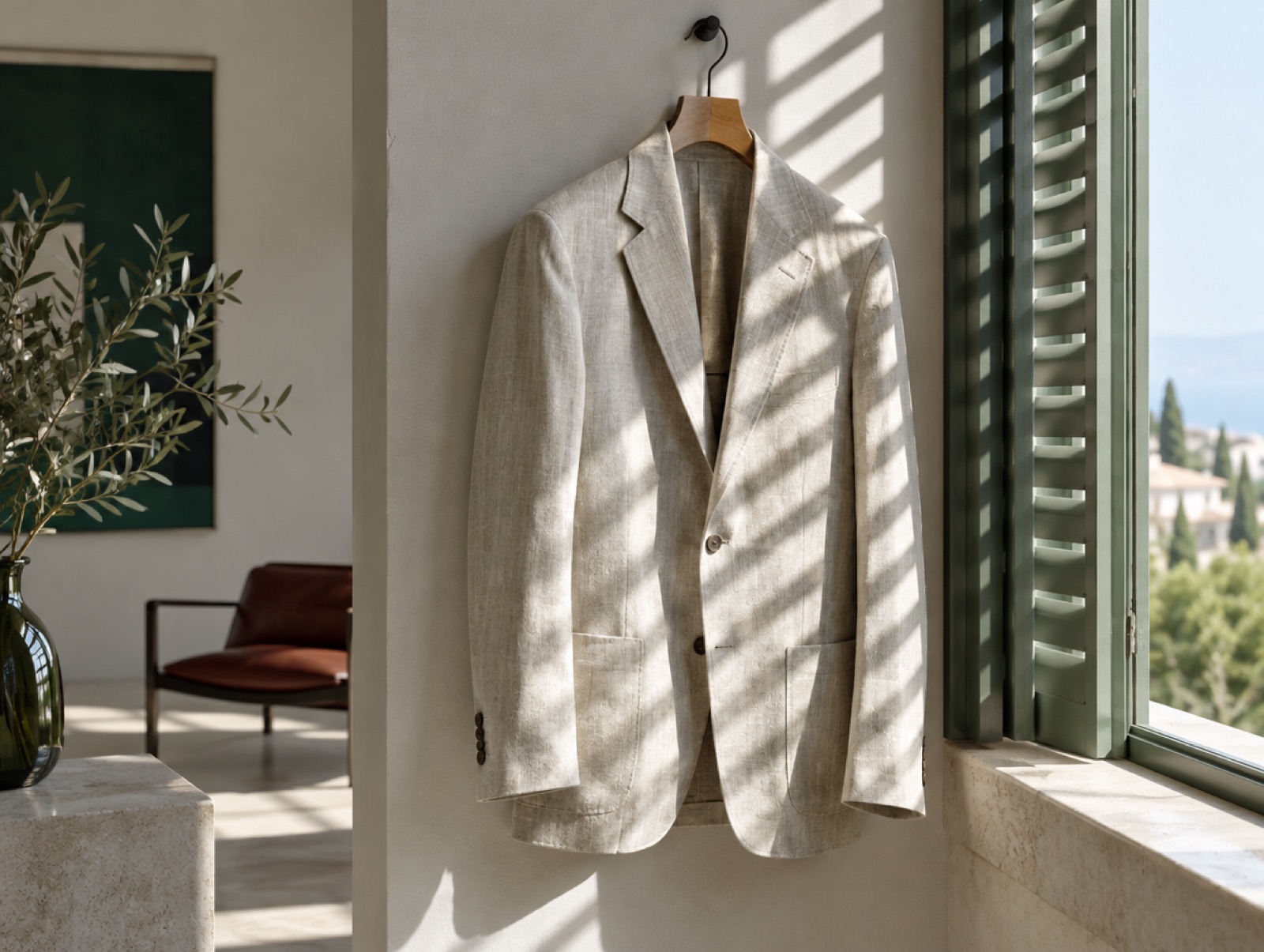
- A linen jacket in Mediterranean sun: Original art · Il Sartoriale · Il Sartoriale · Il Sartoriale original art