Histoire · History
How the necktie happened
Croatian mercenaries, a French court, and a nineteenth-century knot that never went away.
The necktie descends from the cravat, adopted in France in the seventeenth century from the neckcloths worn by Croatian soldiers: the word cravate derives from Croat. It evolved through the elaborate neckwear of the Regency into the long four-in-hand tie of the later nineteenth century, which is essentially what is worn now.
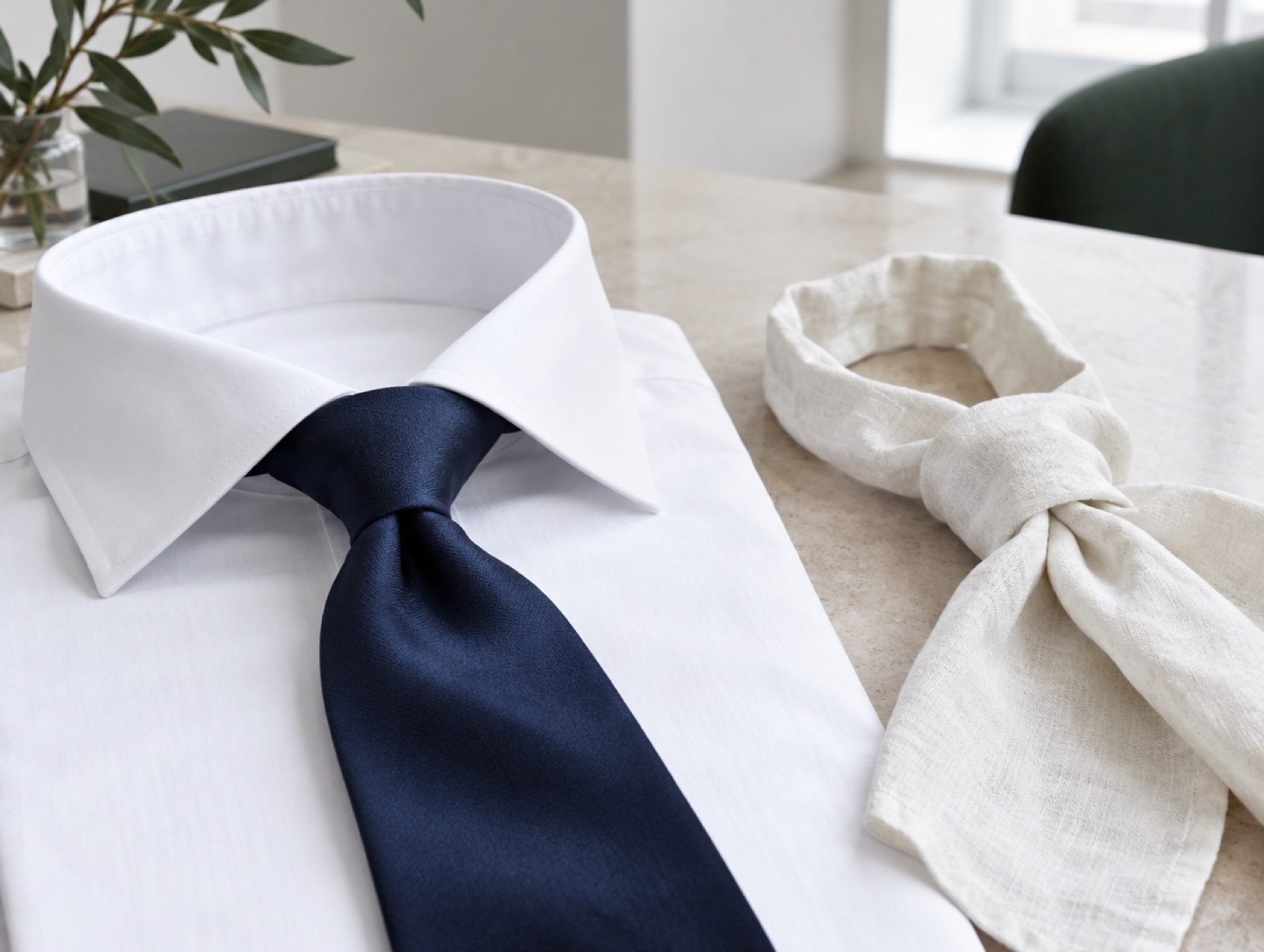
From cravat to tie
Croatian troops in French service in the 1630s wore knotted neckcloths that the French court adopted and named after them. Through the eighteenth century the cravat became increasingly elaborate, and in the Regency period the arrangement of one's neckcloth was a subject of published instruction and genuine competitive seriousness: Brummell is said to have spent hours on it.
The long narrow tie knotted at the throat, the four-in-hand, appears in the later nineteenth century and is the direct ancestor of the modern tie. Its name comes from the knot used to tie the reins of a four-horse carriage, or possibly from a London club; both are asserted and neither is well established.
The bias cut
The construction that makes a modern tie work (cut on the bias, folded around a wool interlining, closed with a single slip stitch) is attributed to Jesse Langsdorf, a New York tie maker, who patented a three-piece bias-cut construction in the 1920s. It is a genuinely consequential piece of design. A tie cut on the straight grain twists and will not knot cleanly; the bias cut lets it stretch and recover. Nearly every tie made since follows it.
The present
Tie wearing has declined faster than any other element of the classic wardrobe, which has had two effects. The mass market has largely abandoned quality, and the specialist market (grenadines from Como, hand-rolled edges, seven-fold constructions) has become more serious than it was. It is now easier to buy an excellent tie and harder to buy a decent cheap one than at any point in a century.
En un coup d'œil
Crédits photographiques 1
- A silk tie knotted beside a linen cravat: Original art · Il Sartoriale · Il Sartoriale · Il Sartoriale original art