Sejarah · History
How the suit happened
The modern suit grew from the coat, waistcoat and breeches of the 1660s English court, simplified by country and riding clothes over two centuries.
The modern suit descends from the coat, waistcoat and breeches adopted at the English court in the 1660s, simplified across the eighteenth and nineteenth centuries under the influence of riding and country dress, and formalised into the lounge suit, which began as informal wear and ended up as the most formal thing most men own.
The Restoration and the three-piece
In October 1666 Charles II announced a new fashion at court: a long coat, a vest beneath it and breeches, replacing the doublet and hose. Pepys records it, which is why the date is known. The garments were elaborate by later standards, but the structure (outer coat, waistcoat, leg covering, all coordinated) is the ancestor of everything since.
What made it consequential was that it was a national rather than a French court fashion, and that it established a three-part outfit as the male standard.
The countryside civilises the coat
The eighteenth century's most important influence on men's dress was English country life. Riding required a coat cut away at the front so it did not sit under the rider, in cloth heavy enough to work in, in colours that did not show mud. Those requirements produced the tailcoat, and later the morning coat.
Beau Brummell, in the first decades of the nineteenth century, took that country practicality into town and made restraint itself the point: dark cloth, immaculate linen, fit above ornament. It is difficult to overstate how completely this replaced the older aesthetic of colour and decoration.
The lounge suit
The lounge suit, a short jacket with matching trousers, appears in the middle of the nineteenth century as informal dress: what a man wore when he was not required to wear a frock coat or morning coat. It was for the country, for holidays, for the seaside.
It rose steadily through the formality hierarchy as everything above it fell away. By the 1920s it was acceptable for business; by the 1950s it was business dress; by the 2000s it was formal wear. The garment did not change nearly as much as its position did.
What changed and what did not
The construction has been remarkably stable. A canvassed chest, a shaped shoulder, a set sleeve and a suppressed waist have been the method since the nineteenth century, and a tailor from 1890 would recognise everything in a modern workroom except the fusible interlining.
What has changed is weight, which has fallen by about a third since the 1950s as buildings became heated; proportion, which moves continuously; and universality, which has collapsed. The suit is now a choice rather than a requirement, which is the largest change of all and the reason the trade looks as it does.
Sekilas pandang
Sumber-sumber
- The Diary of Samuel Pepys, entry for 15 October 1666, Pepys, 1666. Records Charles II's announcement of the new court fashion.
- Menswear collections , Victoria and Albert Museum.
Apabila suatu angka diperdebatkan atau belum dipublikasikan oleh rumah mode, halaman ini menyatakannya alih-alih memilih angka tertentu.
Kredit foto 1
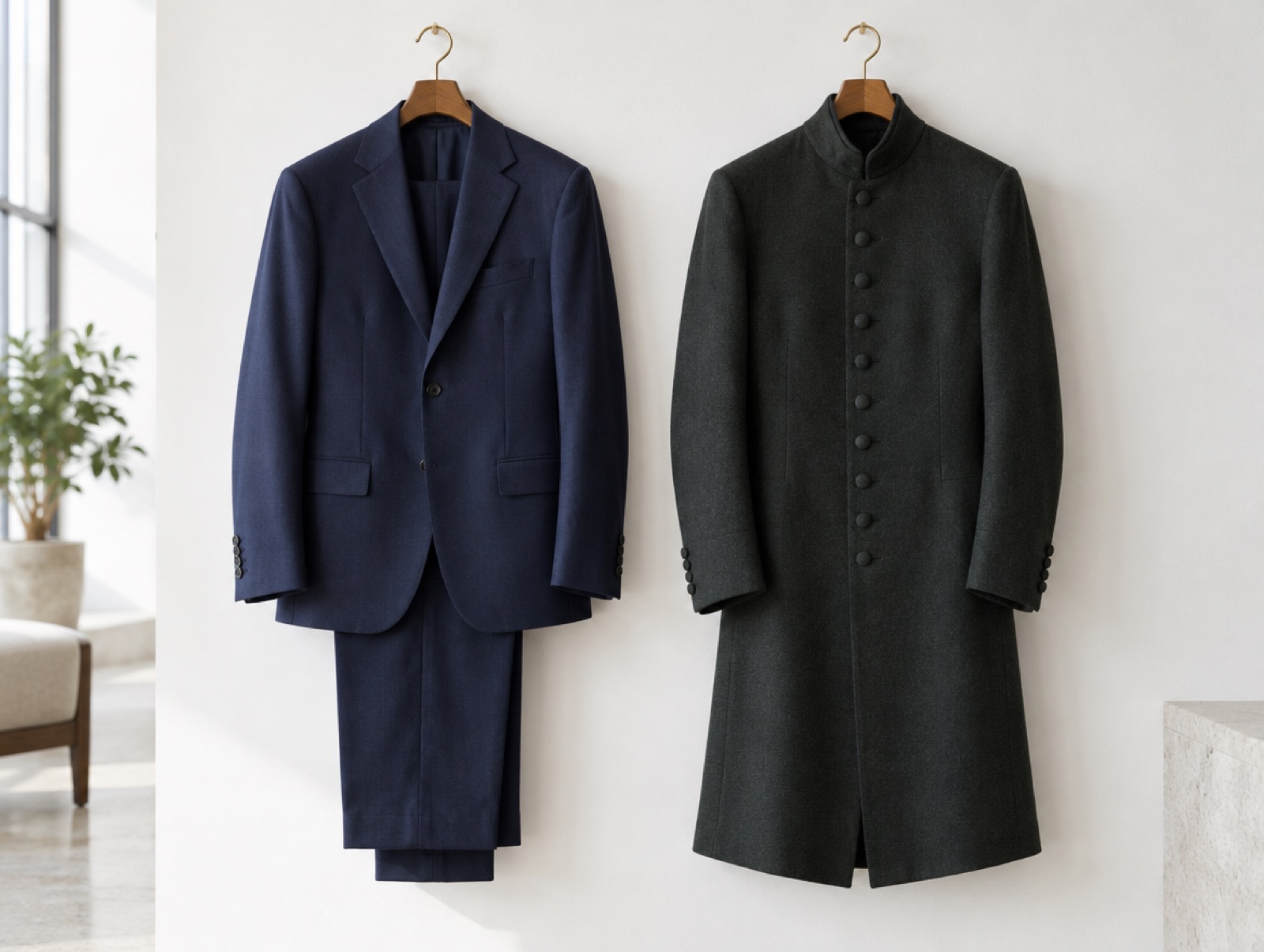
- A modern suit beside a frock coat: Original art · Il Sartoriale · Il Sartoriale · Il Sartoriale original art