Tissu · Fibre
Linen
Linen is made from the flax plant and is the coolest cloth to wear, though it creases instantly and stays creased.
Linen is made from the stem of the flax plant. The fibre is strong, hollow and highly conductive of heat and moisture, which is why linen feels cool in a way cotton does not. It also creases immediately and permanently, which is either the price or the point depending on your temperament.
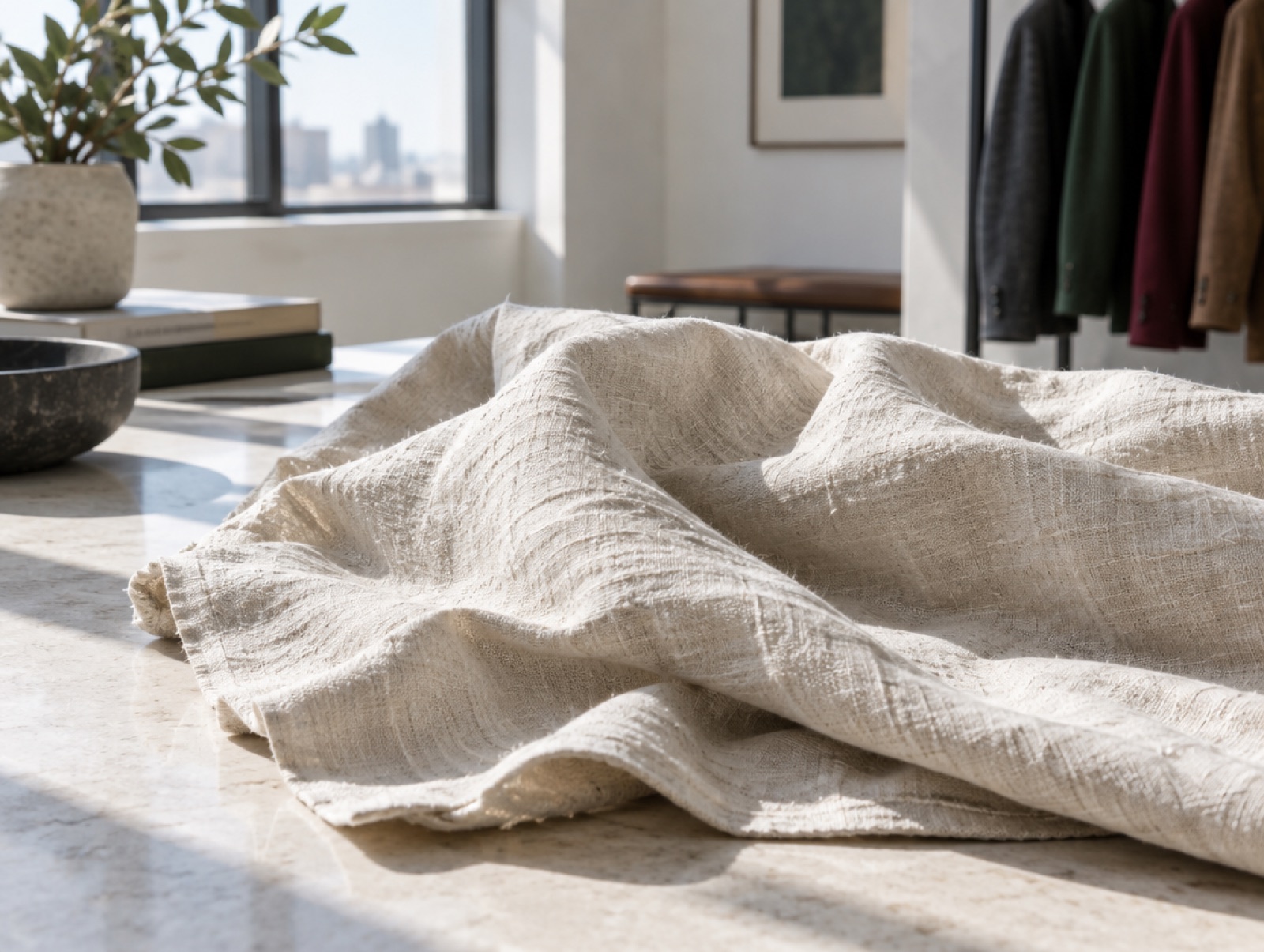
From stem to thread
Flax is grown, pulled rather than cut, then retted: left in the field or in water so bacteria break down the pectin binding the fibre to the woody stem. It is then scutched to remove the woody parts and hackled to comb the fibres straight. The best linen comes from a coastal strip running from northern France through Belgium into the Netherlands, for climatic reasons: flax wants a damp, temperate summer.
The fibre is hollow and conducts heat away from the body quickly, and it absorbs and releases moisture faster than cotton. That combination is why linen feels actively cool rather than merely light.
The creasing
Linen fibre has almost no elasticity (it is stiff and it does not recover), so a fold becomes a crease and stays one. No finish removes this; treatments that claim to reduce it work by adding resin or blending in polyester, both of which reduce the coolness that made linen worth wearing.
The trade's settled position is that this is an aesthetic to be accepted rather than a fault to be corrected. A linen jacket that has been worn for an afternoon looks like a linen jacket that has been worn for an afternoon, and pressing it every morning defeats the object.
Blends and weights
Linen blended with wool crumples less and drapes better while keeping much of the coolness; linen-silk adds lustre and slub; linen-cotton is softer and less cool. Irish linen, a term describing origin of manufacture rather than a specification, is traditionally associated with heavier, crisper cloth.
Weight matters as much as fibre. A 10- or 11-ounce linen tailors far better than a 7-ounce one, holds a shoulder, and creases in large soft folds rather than sharp ones.
En un coup d'œil
Qui travaille avec
Maisons et fabricants présents sur ce site avec un lien documenté avec Linen.
Fabricants et marchands de tissu
Tous les tisseurs →Comparé avec
Toutes les comparaisons →Crédits photographiques 1
- Crumpled ivory linen in window light: Original art · Il Sartoriale · Il Sartoriale · Il Sartoriale original art