Accessoire · Headwear
Hats
A good soft hat is made from felted rabbit or beaver fur, which outlasts wool felt and resists water, and it should suit your shoulders and face.
A good soft hat is made from felted fur (rabbit or, at the top, beaver) which is finer, more water-resistant and more durable than wool felt. Fit and proportion decide whether it works: brim width should relate to shoulder width, and crown height to face length.
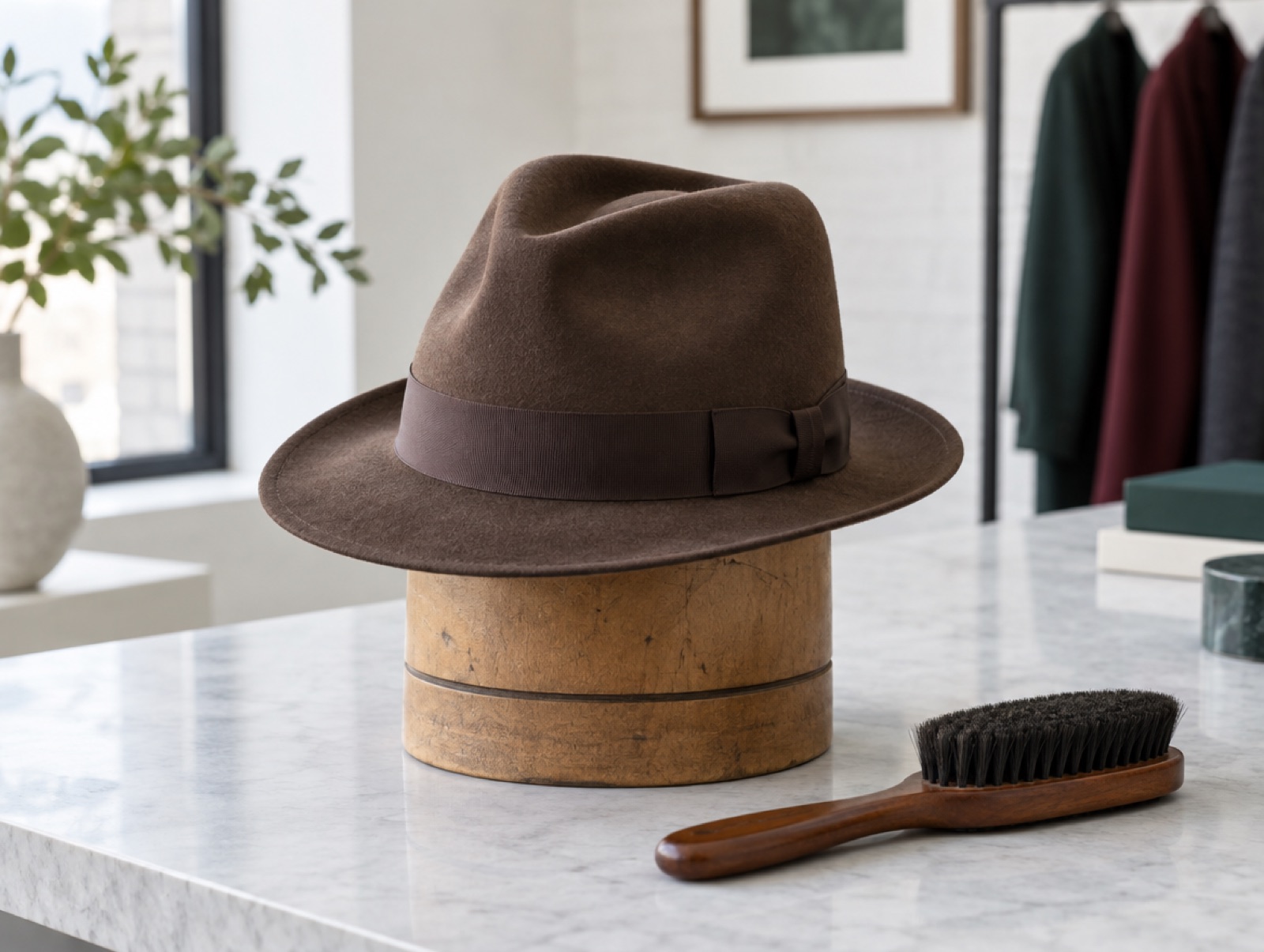
Fur felt against wool felt
Fur felt is made from rabbit or hare fur, which has microscopic barbs that lock together under heat and pressure to produce a dense, smooth, water-shedding material. Beaver is finer still and considerably more expensive. Wool felt is coarser, less water-resistant and does not hold a shape as well.
Quality within fur felt is described in a variety of proprietary systems (X marks and similar) which are not standardised between makers and should not be compared across brands.
Fit
A hat should sit level, roughly a finger's width above the ear, and stay on in a moderate wind without being tight. Sizes are measured around the head just above the ears; a hat that leaves a red line is too small and one that shifts when you turn is too large.
Fur felt can be stretched slightly by a hatter and shrunk slightly with steam, which is why buying from someone who can adjust it matters.
Proportion
The two variables are brim width and crown height, and both should relate to the wearer. Broad shoulders carry a wider brim; a long face is balanced by a lower crown. A hat too small for the head and shoulders reads as costume, which is the failure mode that has made hats difficult to wear well since they stopped being universal.
The panama is a different object: hand-woven from toquilla palm in Ecuador, graded by the fineness of the weave, and expensive at the top in a way that surprises people.
Handling and storage
Pick a hat up by the brim front and back, never by pinching the crown; that is what wears the crease through. Store it upside down on its crown, or on a hat block, so the brim keeps its shape.
Rain will not ruin a fur felt hat; heat will. Let a wet hat dry at room temperature, upside down, and brush it when dry.
En un coup d'œil
Crédits photographiques 1
- A felt fedora on a hat block: Original art · Il Sartoriale · Il Sartoriale · Il Sartoriale original art