Craftsman · Artisans
Lorenzo and Massimo Cifonelli
Lorenzo and Massimo Cifonelli are cousins running the family's Paris tailoring house, famous for a built-up shoulder that rolls into the sleeve instead of sitting flat.
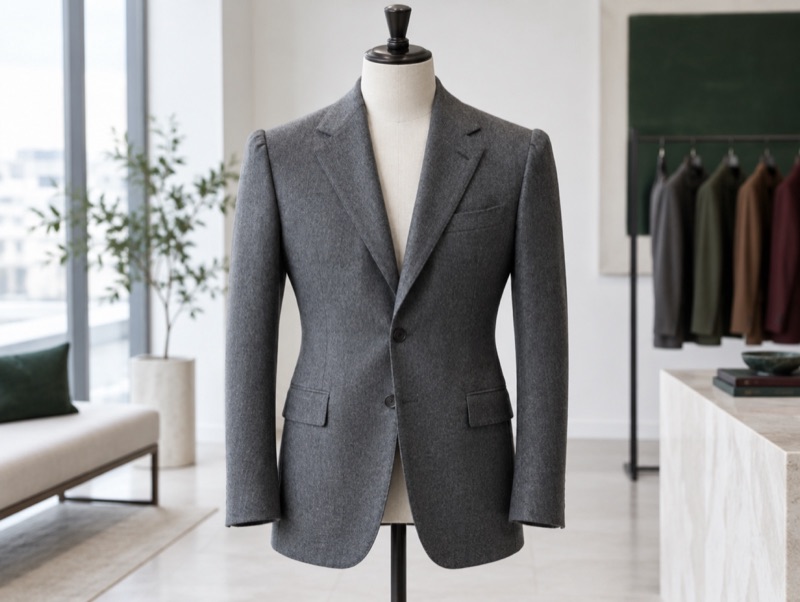
The third generation of the Cifonelli family, both cutting in the Paris workshop. The house's sculpted shoulder, built up and rolled into the sleeve head rather than padded flat, is the most identifiable detail in contemporary tailoring and requires hours of work no other construction demands.
The shoulder as a technical problem
Building a shoulder that rises and rolls in a continuous curve, over a chest cut very close and pressed clean, is a construction problem rather than a decorative one. The layers have to be shaped, positioned and sewn so the form holds and the coat still moves.
It cannot be approximated by padding, and it is the reason the house sits at the top of the international price range along with the Milanese firms.
The Roman inheritance
The family traces its tailoring to Rome in the 1880s and established in Paris in the 1920s, which is why the Parisian style is neither straightforwardly French nor Italian. Its combination (Italian shaping instincts, French drama, English discipline) is a product of that migration.
The house travels heavily, particularly to New York and Tokyo, and a substantial share of its work is commissioned away from Paris.
Working with the house
Three to five fittings for a first commission and a lead time measured in many months. A substantial share of the work is taken at trunk shows in New York and Tokyo, which extends the calendar further.
The house also makes ready-to-wear and made-to-measure, and the bespoke is a distinct and considerably more expensive product. As with every house offering all three, the question worth asking is which one a particular garment is.
Two cousins, one shoulder
Lorenzo and Massimo Cifonelli run the house together, one principally on the cutting and one on the workroom, and the division matters because the house's signature is not a pattern but an assembly: the shoulder is built, and building it is a workroom skill rather than a cutting-board one. It is the clearest current example of a detail that cannot be copied from a photograph, which is why so many attempts at it are unconvincing.
At a glance
Houses working in this tradition
Picture credits 1
- An illustration of the house's recorded cut: roped shoulder, full canvas chest, sculpted shoulder, very clean close chest, high waist. Not a photograph of the house's own work.: Original art · Il Sartoriale · Il Sartoriale · Il Sartoriale original art