Merk · France
Hermès
Hermès is a family-controlled Paris luxury house, founded as a harness maker, known for leather bags, small goods and shoes, and it owns John Lobb Paris.
Hermès was founded in Paris in 1837 as a harness workshop and remains family-controlled. Its authority comes from leather: saddlery techniques carried into bags, small goods and shoes, with single-craftsman production and a refusal to license the name. It owns John Lobb Paris.
Saddlery discipline
The saddle stitch, two needles worked in opposite directions through the same hole, by hand, is Hermès's technical foundation and comes directly from harness making. It cannot be machine-replicated, it does not unravel when cut, and it is the reason the company's leather goods are built the way they are.
The other inheritance is organisational: a single artisan makes a bag from start to finish and signs it. That is inefficient and it is the point.
In menswear
Hermès makes ready-to-wear, including soft tailoring and leather blousons, and its leather jackets in particular are among the most expensive garments in the category. It also owns John Lobb Paris.
The company's restraint about licensing and distribution (no licensed products, controlled supply) is the clearest counterexample in luxury to the strategy most of its competitors adopted in the 1990s.
The saddle stitch
Two needles on one thread, worked in opposite directions through the same hole, each stitch locking the last. It cannot be done by machine (a machine lockstitch is one thread caught by another) and if the thread is cut, a saddle-stitched seam does not run.
It is slow. A bag represents many hours of one artisan's work, and the company's refusal to break that into an assembly line is the clearest example in luxury of a production decision that is genuinely about the object rather than about the story.
Still a harness maker
The house began making harness and saddlery, and the leather disciplines that came from that work (saddle stitching by hand with two needles, edge finishing, the treatment of a hide as a structural material) still govern how it makes everything else. It is the most disciplined of the large luxury companies about what it will and will not put its name on, and the restraint is a business strategy as much as a taste: scarcity maintained deliberately over decades.
In één oogopslag
Wat het kost
Prijzen op de gehele site →Dit zijn geen offertes. De onderstaande prijzen zijn de meest recente cijfers die wij aan een bron konden toeschrijven, weergegeven in de valuta waarin ze zijn gepubliceerd.
| Wat | Service | Prijs | Waargenomen |
|---|---|---|---|
| Leather blousonAn indicative band, not a quotation. Bespoke entry prices normally exclude tax and cloth beyond the house bunch, and houses raise them without announcement. | Ready To Wear | €8,000–20,000 | September 2026 |
Fotorechten 1
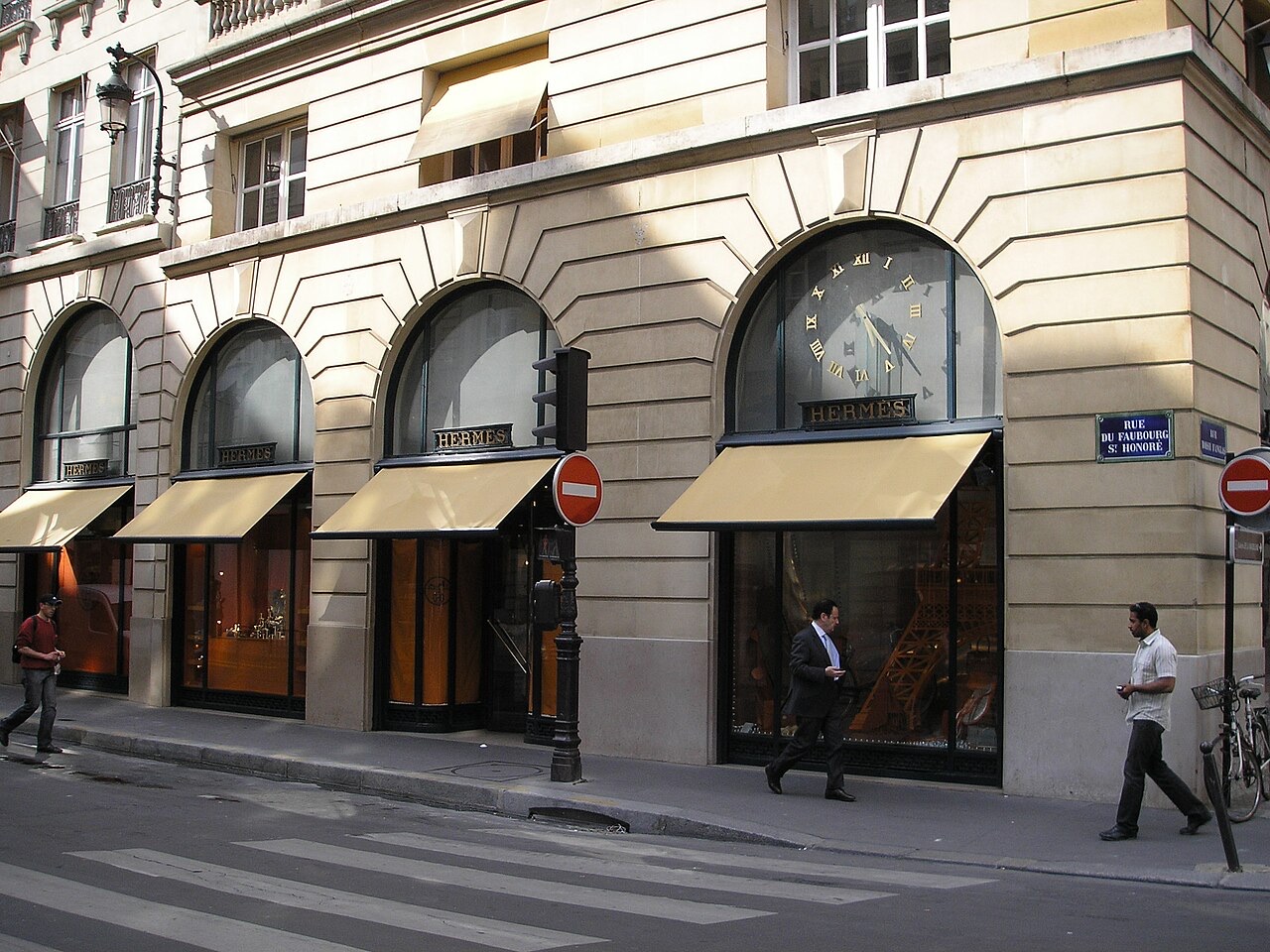
- Rue du Faubourg-Saint-Honoré, Paris May 2006: Photograph · Gryffindor · Wikimedia Commons · Public domain