Marque · Ownership
Prada
Prada is a Milan fashion group that began as a leather goods house, and it has owned the Northampton shoemaker Church's since 1999.
Prada was founded in Milan in 1913 as a leather goods house and is now a listed fashion group. Within the scope of this site, its relevant holding is Church's, the Northampton shoemaker, acquired in 1999.
In this context
Prada's fashion output is outside this site's scope; its ownership of Church's is not. The Northampton factory continues under Prada ownership and the English-made welted range remains, alongside a considerably broadened offering.
The pattern (a fashion group acquiring a traditional shoemaker and expanding the range) has repeated across the industry and is worth noticing when a heritage name suddenly appears on unfamiliar products.
A pattern worth recognising
A fashion group acquires a traditional maker with a strong name, keeps the original factory, and extends the name across a much wider range of products made elsewhere. It has happened repeatedly across menswear.
The original product usually survives. What disappears is the reliability of the name as a shorthand, which is precisely what the acquirer paid for.
Church's since 1999
The Northampton factory continues and the English-made Goodyear-welted range remains a decent shoe. The broader offering has expanded considerably, including footwear made elsewhere to different specifications, and the brand's positioning has moved towards fashion. The consequence for a buyer is that the name alone no longer identifies a product. Two shoes sold under it can differ in country, construction and repairability, and the specification has to be read.
En un coup d'œil
Crédits photographiques 1
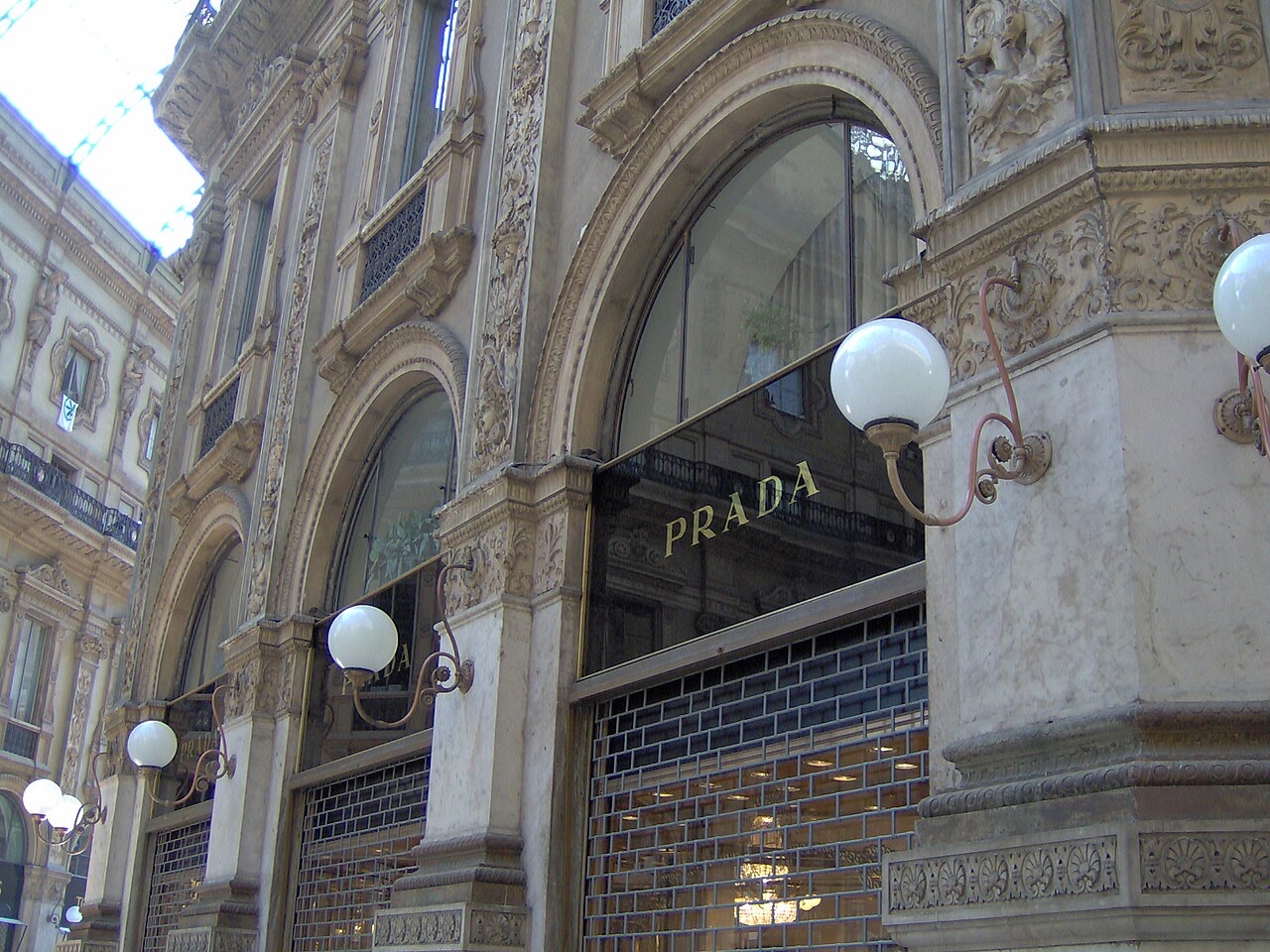
- Prada boutique at the Galleria Vittorio Emanuele II in Milan, Italy: Photograph · (Per Andersson) ( Nrkpan ) · Wikimedia Commons · CC BY-SA 3.0