Kleidungsstück · Outerwear
The trench coat
The trench coat is a belted, double-breasted cotton raincoat made for British officers in the First World War, whose practical details now survive as decoration.
The trench coat is a belted, double-breasted rain coat in cotton gabardine, developed for British officers in the First World War. Its details (storm flap, epaulettes, D-rings, raglan sleeves, the throat latch) were functional then, and they survive as decoration.
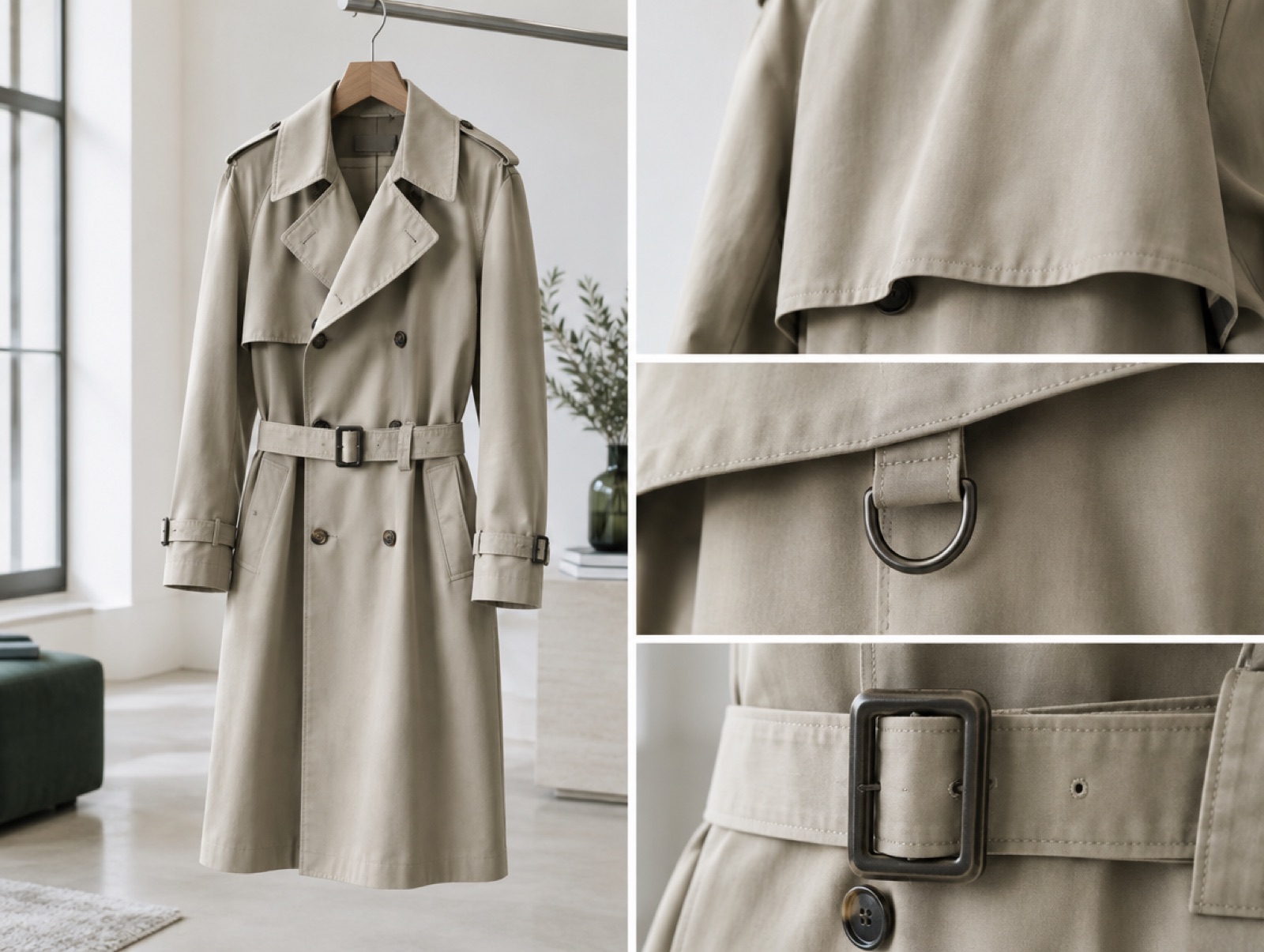
Every feature had a reason
- Gabardine. Thomas Burberry's densely woven twill: rain-resistant without rubber, and breathable.
- Storm flap across the right shoulder, so water runs off the chest rather than through the button front.
- Epaulettes to hold rank insignia, and to keep a gas mask strap or binocular case from sliding.
- D-rings on the belt, generally for equipment. The story that they carried grenades circulates widely and is not documented.
- Raglan sleeves for movement, and a deep back yoke for ventilation.
- Length to the calf, to keep mud off the uniform.
Buying one
Cotton gabardine is the correct cloth and the reason a trench coat behaves as it does: it should be crisp, dry to the hand and slightly stiff, not soft. A soft trench coat is made from the wrong material.
The proportions have moved a great deal. The original is generous, long and worn over a suit; the modern slim, short version is a different garment wearing the same details.
Proportion
The original is cut generously and long, because it went over a uniform and reached the calf. Most modern versions are shorter and slimmer, which changes the garment: a short slim trench cannot be worn over a suit jacket without pulling, which removes its only functional purpose.
If it will be worn over tailoring, buy for the jacket underneath and accept that it will look large without one. That is what it is for.
Auf einen Blick
Bildnachweise 1
- A gabardine trench coat: Original art · Il Sartoriale · Il Sartoriale · Il Sartoriale original art