沿革 · History
How Savile Row happened
Savile Row filled with tailors around 1800 to be near aristocratic clients, and it is now a small trade with a famous name and too few makers.
Tailors began moving into the streets around Savile Row around 1800, drawn by proximity to their aristocratic clientele. Military and court work built the street's reputation and its finances; the twentieth century removed both. What survives is a small trade with an enormous name and a genuine shortage of makers.
Why that street
Savile Row was built in the 1730s as part of the Burlington Estate and was originally occupied largely by military officers and, later, physicians. Tailors arrived around the turn of the nineteenth century because their customers lived in the surrounding streets, the same clustering logic that put shoemakers in Northampton and weavers in Biella.
Henry Poole moved to the corner of the street in the 1840s and is the founding presence. By the middle of the century the Row was established as the address.
Uniforms and empire
The nineteenth-century Row was built on military, court and livery tailoring as much as on civilian suits. Uniform work is technically demanding, regularly repeated and reliably paid, and it sustained the street through periods when fashion did not.
Two of the surviving houses, Gieves & Hawkes and Dege & Skinner, still do it, and their civilian cutting shows the inheritance.
The long contraction
The twentieth century removed the Row's structural advantages one at a time. Ready-to-wear took the middle market. The dress code relaxed, then collapsed. Mayfair rents rose enormously. And the apprenticeship system thinned through the 1980s and 1990s, so that the binding constraint today is not customers but trained coatmakers.
The responses have been varied: ready-to-wear and made-to-measure lines, offshore making at some houses, new firms founded by departing cutters, and, in 2004, the Savile Row Bespoke Association, which sets minimum standards for its members on a voluntary basis.
The street is smaller than it was and its work is not worse. What is genuinely at risk is transmission: a coatmaker takes years to train and there are not enough people training.
The word
Bespoke comes from cloth being 'spoken for' by a customer, and the distinction it draws, a pattern cut for one person, is the one that still matters. In 2008 the UK Advertising Standards Authority declined to restrict the word to individually patterned garments, which is why it now appears on a wide range of products.
The Row's own response has been the Association's standards rather than the law's.
概要
出典
- Standards for members , Savile Row Bespoke Association.
数値に異論がある場合、またはハウスが公表していない場合、このページは数値を選択するのではなく、その旨を明記します。
写真クレジット 1
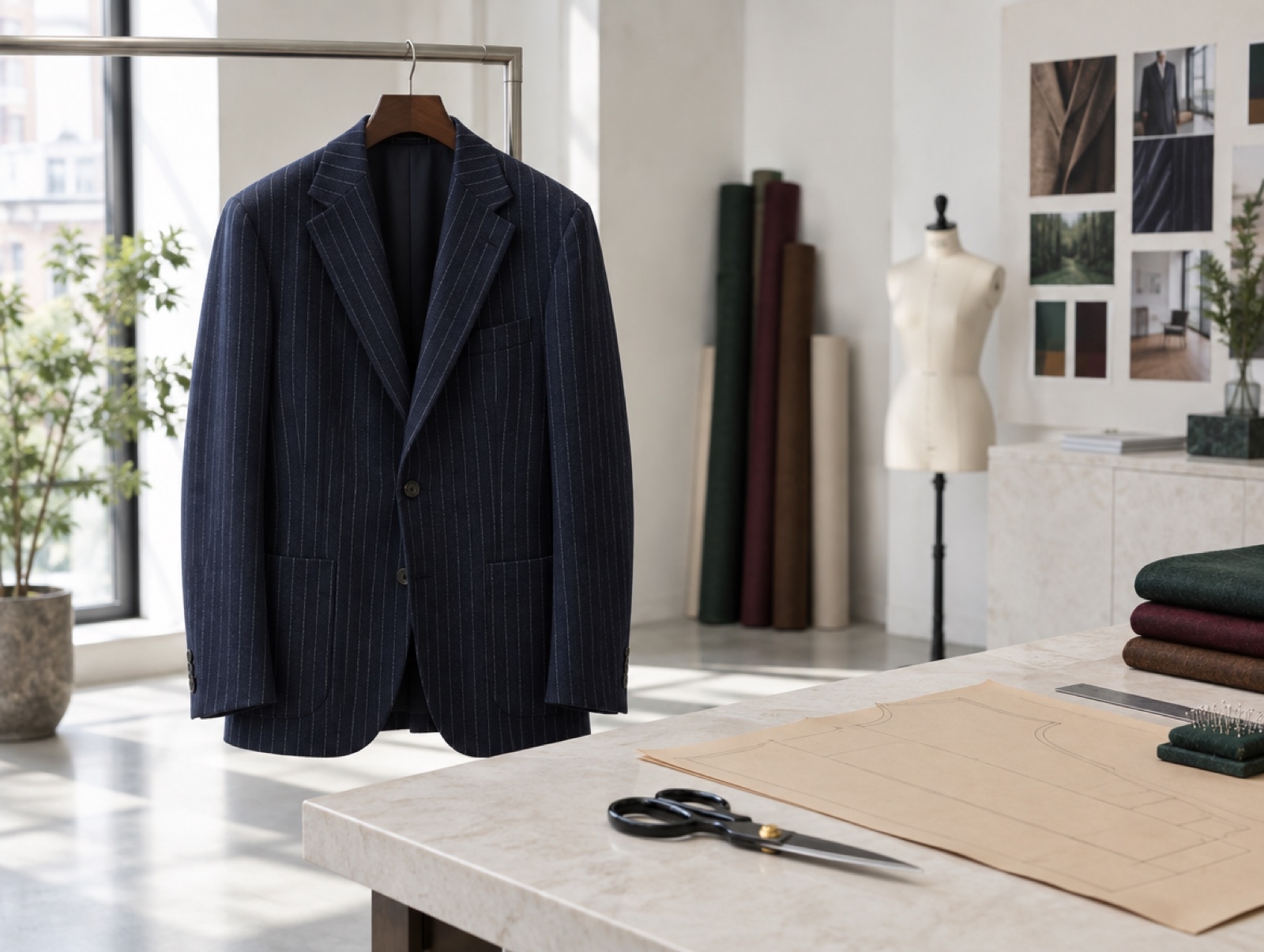
- A chalk-stripe jacket in a bright cutting room: Original art · Il Sartoriale · Il Sartoriale · Il Sartoriale original art