Histoire · History
How the dinner jacket happened
The dinner jacket started as a blue silk coat Henry Poole made for the Prince of Wales in 1865, and Americans named it after Tuxedo Park.
In 1865 Henry Poole & Co made a short smoking coat in blue silk for the Prince of Wales to wear at Sandringham instead of a tailcoat. The order is recorded in Poole's ledgers. It reached America through a guest who had one made and wore it at the Tuxedo Park club, which is why Americans call it a tuxedo.
The order
Poole's ledgers record a short evening coat made for the Prince of Wales, later Edward VII, in 1865. It was a smoking jacket in form (soft, shawl-collared, for wearing after dinner at home), made in a formal cloth and intended as an alternative to the tailcoat in private company. This is unusually well documented for a menswear origin story, precisely because the house kept order books and still has them. Most such stories rest on nothing.
Tuxedo Park
The commonly told sequence is that James Brown Potter, an American visiting England, was advised by the Prince to have such a coat made, and wore it on returning to the Tuxedo Park club in New York, where it was adopted. Details of who exactly wore it first and when are told several ways.
What is not in dispute is that the garment entered American use through Tuxedo Park and took the club's name with it. The English kept calling it a dinner jacket; the French and Italians called it a smoking, after its ancestor.
What it displaced
White tie, which was the standard evening dress and remained so for formal occasions well into the twentieth century. The dinner jacket began as the relaxed alternative and followed the same trajectory as the lounge suit: informal option, then standard, then the formal end of what anyone actually wears.
Midnight blue became a preference in the interwar years for a specific reason: under artificial light it reads blacker than black, which appears washed out. The convention survives and the reasoning is still correct.
En un coup d'œil
Crédits photographiques 1
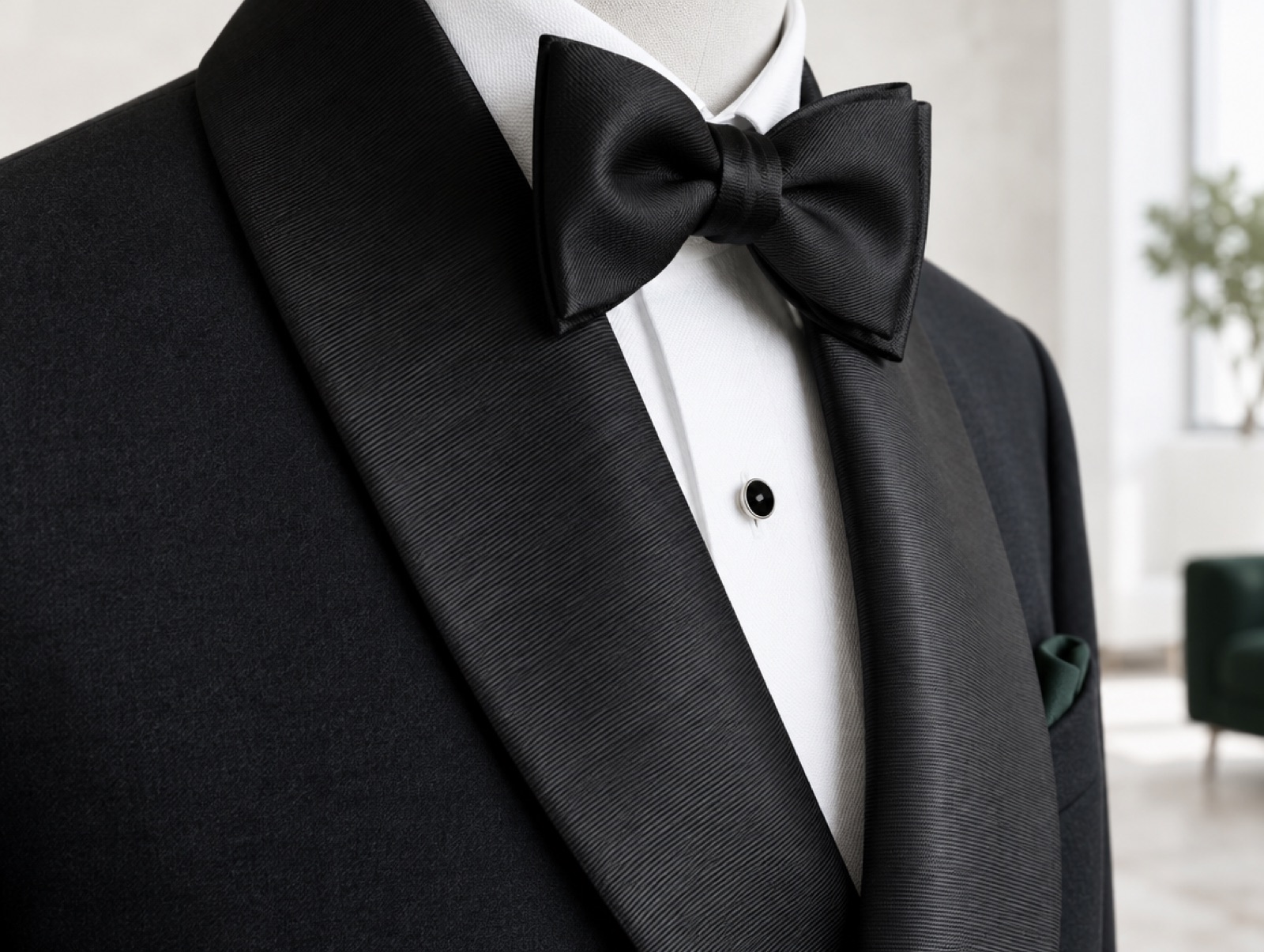
- A grosgrain shawl lapel with a bow tie: Original art · Il Sartoriale · Il Sartoriale · Il Sartoriale original art