Fabric · Fibre
Cashmere
Said KASH-meer
The undercoat of a goat that lives somewhere very cold, combed out by hand each spring.
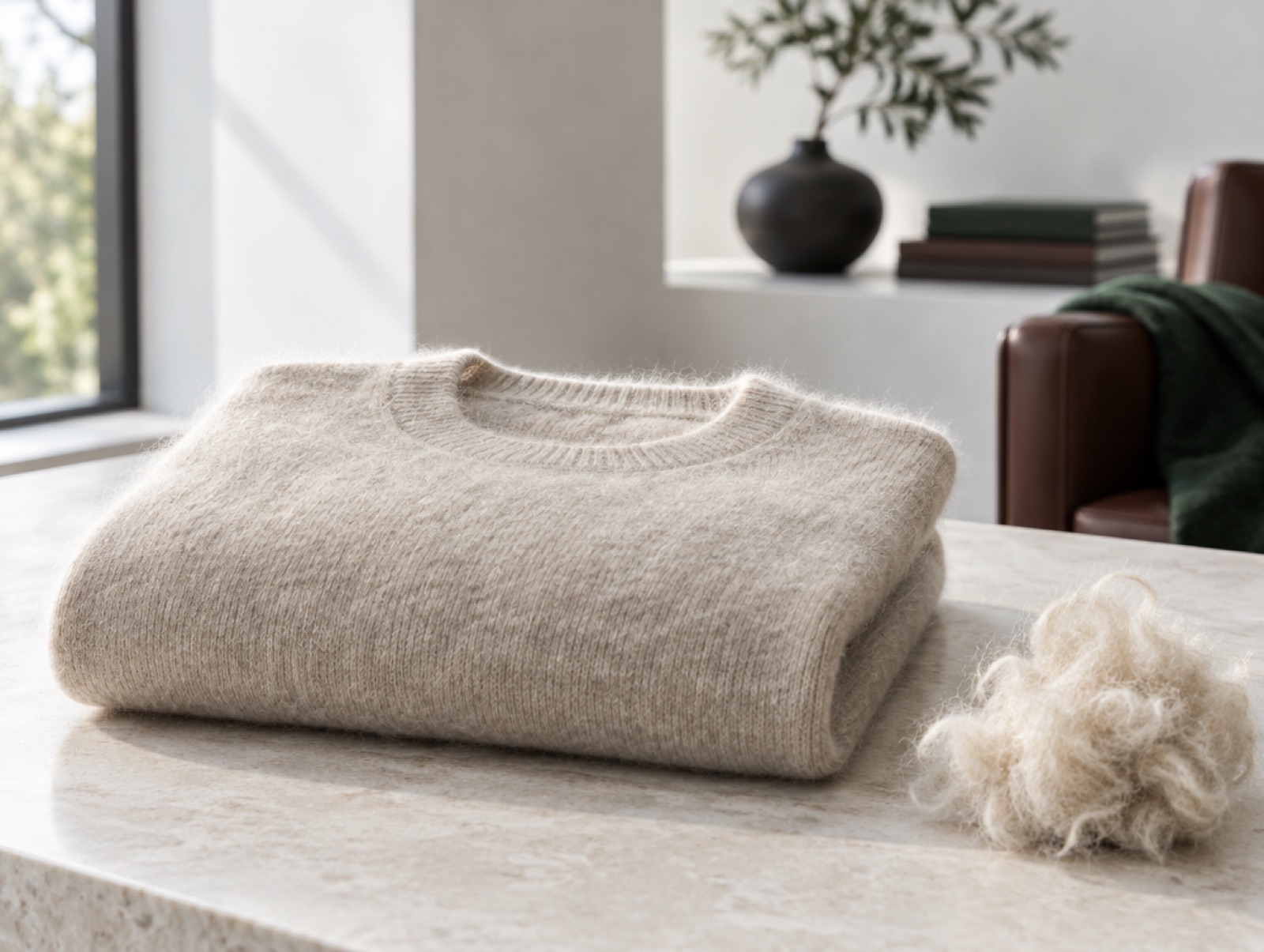
Cashmere is the soft downy undercoat of certain goats, grown to survive a Himalayan or Mongolian winter and shed each spring. It is finer than the finest wool, exceptionally warm for its weight and very soft, and because each goat yields a few ounces a year, it has always been expensive. Much of what is now sold as cashmere is not what the word used to mean.
Where it comes from
From goats living at altitude in Mongolia, northern China, Iran and Afghanistan, whose winter coat has two layers: a coarse outer guard hair and a fine, dense undercoat. The undercoat is the cashmere. It is combed or shorn out in spring as the animal moults, then dehaired: a mechanical process separating the fine down from the coarse guard hair, and the step that determines quality more than any other.
The name comes from Kashmir, which was the trade route into Europe rather than the main source. The shawls that made cashmere famous in eighteenth- and nineteenth-century Europe were woven there.
Why the good stuff is rare
A goat yields something in the region of 150 to 200 grams of usable cashmere a year; a sweater needs the output of several animals. Total world production is a fraction of a percent of world wool production. That arithmetic has not changed; what has changed is that cashmere is now sold at every price point, which means something else has changed instead.
What changed is the fibre being used. Cashmere is graded on diameter and, critically, on length. Long, fine fibre spins into a smooth strong yarn that holds together. Short fibre, the same diameter, but from poorer combings or heavily dehaired lots, spins into a yarn whose fibre ends work loose. That is what pilling is: short fibre ends migrating out of the yarn and tangling.
A £60 cashmere sweater is not fake. It is short-fibre cashmere, often loosely spun and brushed to feel soft in the shop, and it will pill within a season. A £400 one is long-fibre cashmere spun tightly, which feels less immediately plush and stays looking like a sweater for a decade.
Judging it in the shop
- Rub the surface firmly with your palm for a few seconds. If a haze of loose fibre appears, it will pill.
- Stretch a section and let go. Good cashmere springs back; poor cashmere stays stretched.
- Feel for slipperiness. Excessive softness on the shelf often means heavy brushing, which lifts short fibre ends to the surface: the plushness now is the pilling later.
- Two-ply or heavier knits generally outlast single-ply, all else equal, though a good single-ply beats a bad two-ply.
Specifications
| Measure | Typical range | Note |
|---|---|---|
| Fibre diameter | 14–19 µm | Finer than superfine merino; the best around 14–15 µm |
| Fibre length | 28–45 mm | The quality variable that actually predicts pilling; rarely disclosed |
| Yield per goat per year | roughly 150–200 g | After dehairing; varies widely by herd and region |
| Baby cashmere | 13–14 µm | First combing of a young goat; finer, shorter, more delicate |
Baby cashmere and where it sits
Baby cashmere is the first combing from goats under about a year old, finer than adult cashmere and correspondingly scarcer, since one young animal yields very little. It is genuinely softer. It is also shorter-fibred, which means a baby cashmere garment is not more durable than a good adult one; it is a different trade-off, sold at a considerable premium.
Loro Piana is the name most associated with commercialising it. Whether the difference is worth the multiple is a judgement, and this site's is that for a garment worn often, long-fibre adult cashmere is the better object.
At a glance
Who works with it
Houses and mills on this site with a documented connection to Cashmere.
-
 Kiton
Brand · Naples · 1968
Kiton
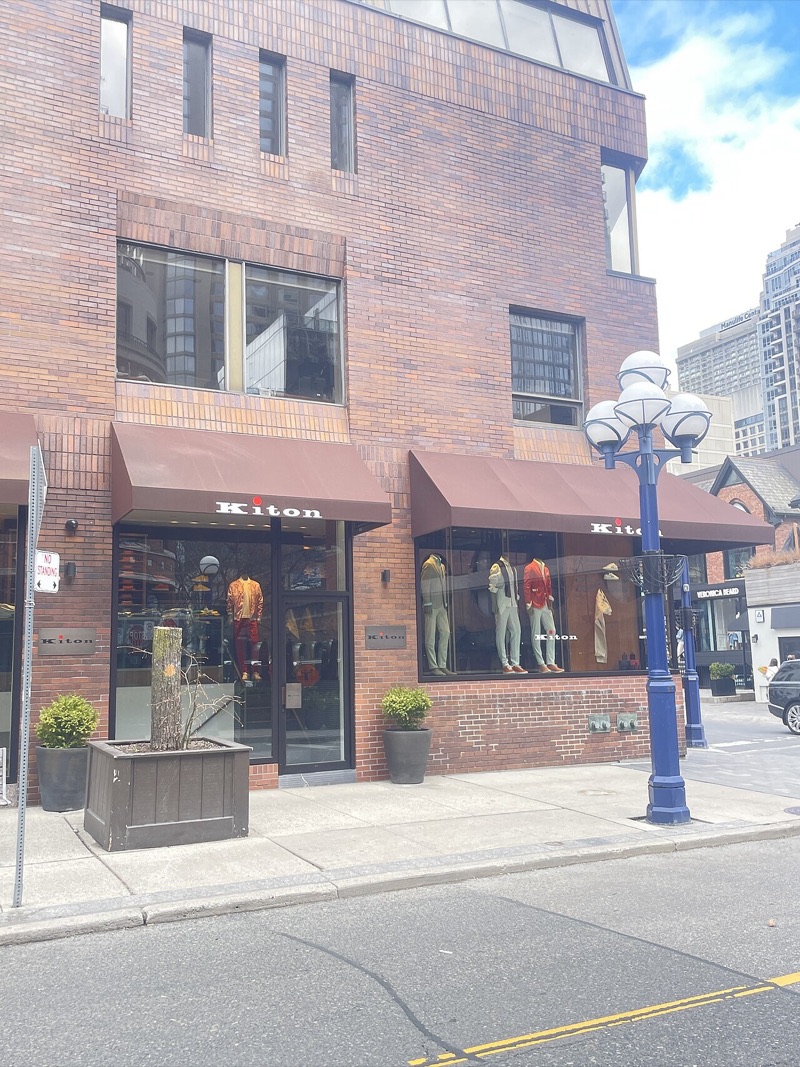
Brand · Naples · 1968Ciro Paone's answer to the question of whether Neapolitan handwork could be industrialised without being ruined.
-
Brunello Cucinelli
Brand · 1978
Brunello Cucinelli is a cashmere brand based in the Umbrian village of Solomeo, known for soft, muted, expensive clothes and its founder's "humanistic capitalism" philosophy.
-
Loro Piana
Cloth maker · Biella · 1924
Loro Piana began as a Biella wool mill and is now a big luxury clothing house, famous for rare fibres like vicuña and baby cashmere.
-
Carlo Barbera
Cloth maker · Biella
Carlo Barbera was a small Biella mill whose fine wool and cashmere-blend cloths won over custom tailors, and Kiton now owns it and uses its cloth.
-
Dormeuil
Cloth maker · Paris · 1842
Dormeuil is a Paris cloth merchant founded in 1842 to sell English cloth in France, now known for rare-fibre fabrics and very expensive limited ranges.
Cloth makers and merchants
All mills →-
Loro Piana
Biella · 1924
Loro Piana began as a Biella wool mill and is now a big luxury clothing house, famous for rare fibres like vicuña and baby cashmere.
-
Carlo Barbera
Biella
Carlo Barbera was a small Biella mill whose fine wool and cashmere-blend cloths won over custom tailors, and Kiton now owns it and uses its cloth.
-
Dormeuil
Paris · 1842
Dormeuil is a Paris cloth merchant founded in 1842 to sell English cloth in France, now known for rare-fibre fabrics and very expensive limited ranges.
What it is used for
Compared with
All comparisons →Sources
- Cashmere and camel hair standards , Cashmere and Camel Hair Manufacturers Institute.
Where a figure is disputed or a house has not published it, the page says so rather than choosing a number.
Picture credits 4
- A folded cashmere sweater with a tuft of raw fibre: Original art · Il Sartoriale · Il Sartoriale · Il Sartoriale original art
- IMG Kiton Toronto: Photograph · Shanmeichen · Wikimedia Commons · CC BY 4.0
- A stack of three sweaters: Original art · Il Sartoriale · Il Sartoriale · Il Sartoriale original art
- A charcoal double-breasted overcoat: Original art · Il Sartoriale · Il Sartoriale · Il Sartoriale original art