Fabricant de tissu · Mill
Loro Piana
Loro Piana began as a Biella wool mill and is now a big luxury clothing house, famous for rare fibres like vicuña and baby cashmere.
Loro Piana began as a Biellese wool mill and is now both a textile business and one of the largest luxury clothing houses. It is the name most associated with vicuña, baby cashmere and the very finest wools, and it has invested directly in the supply chains for them. It has been majority-owned by LVMH since 2013.
Mill and brand at once
Loro Piana occupies an unusual position: it weaves and finishes cloth sold to tailors and other brands, and it sells finished clothing under its own name at the top of the luxury market. Most businesses do one or the other.
The consequence is that the name means different things depending on where you meet it. A Loro Piana cloth in a tailor's bunch is a textile decision; a Loro Piana sweater in a boutique is a brand purchase at a considerable premium over the same fibre from a less famous knitter.
The rare fibres
Loro Piana's distinguishing move was to go upstream. It worked to secure vicuña supply in Peru, including investment in a reserve, at a time when the fibre was barely commercially available; it did comparable work commercialising baby cashmere from Inner Mongolia; and it runs long-standing competitions and premiums for the world's finest bales of merino.
This is genuinely unusual, and it is also a competitive position rather than a philanthropic one, securing scarce supply is what makes the products defensible at their prices. Both things are true.
The Record Bale
The mill runs annual competitions for the finest bales of merino from Australia and New Zealand, awarding a premium for the lowest micron counts. Winning clips have measured below 11 microns, which is finer than vicuña.
Cloth woven from wool at that fineness is extraordinarily soft and correspondingly fragile: a demonstration piece rather than a suiting, and priced as one.
Ownership
LVMH acquired a majority stake in 2013, with the Loro Piana family retaining a minority. The mill operations and the Biella base continue. Ownership by a large group is not by itself an indictment (it has funded supply-chain investment), but it is a material fact about a brand whose marketing rests on family continuity, and it belongs on the record.
The fibre business behind the brand
Loro Piana's public face is a luxury clothing brand; the substance underneath is a fibre-buying operation with long-standing access to the finest wool and cashmere clips and to vicuña. Buying at that level is a specialist trade with its own auctions, relationships and grading, and it is the part of the business that would be hardest for a competitor to reproduce.
For a tailoring customer the useful distinction is between the mill's cloth, which tailors buy by the metre, and the brand's ready-to-wear, which is a separate proposition at a separate price.
En un coup d'œil
Qui travaille avec
Maisons et fabricants présents sur ce site avec un lien documenté avec Loro Piana.
Ce que cela coûte
Les prix sur le site →Ce ne sont pas des devis. Les prix indiqués ci-dessous sont les chiffres les plus récents que nous ayons pu attribuer à une source, présentés dans la devise de leur publication.
| Quoi | Service | Prix | Observé |
|---|---|---|---|
| Cashmere sweaterIndicative band for the house's own knitwear at full retail; varies widely by yarn and model. | Ready To Wear | $1,200–2,500 | September 2026 |
| Vicuña overcoatIndicative band. Vicuña outerwear is made in very small numbers and priced per piece. | Ready To Wear | $20,000–45,000 | September 2026 |
Sources
- Company information and fibre sourcing , Loro Piana.
- LVMH acquisition of a majority stake in Loro Piana , LVMH, 2013.
Lorsqu'un chiffre est contesté ou qu'une maison ne l'a pas publié, la page l'indique plutôt que de retenir un nombre.
Crédits photographiques 1
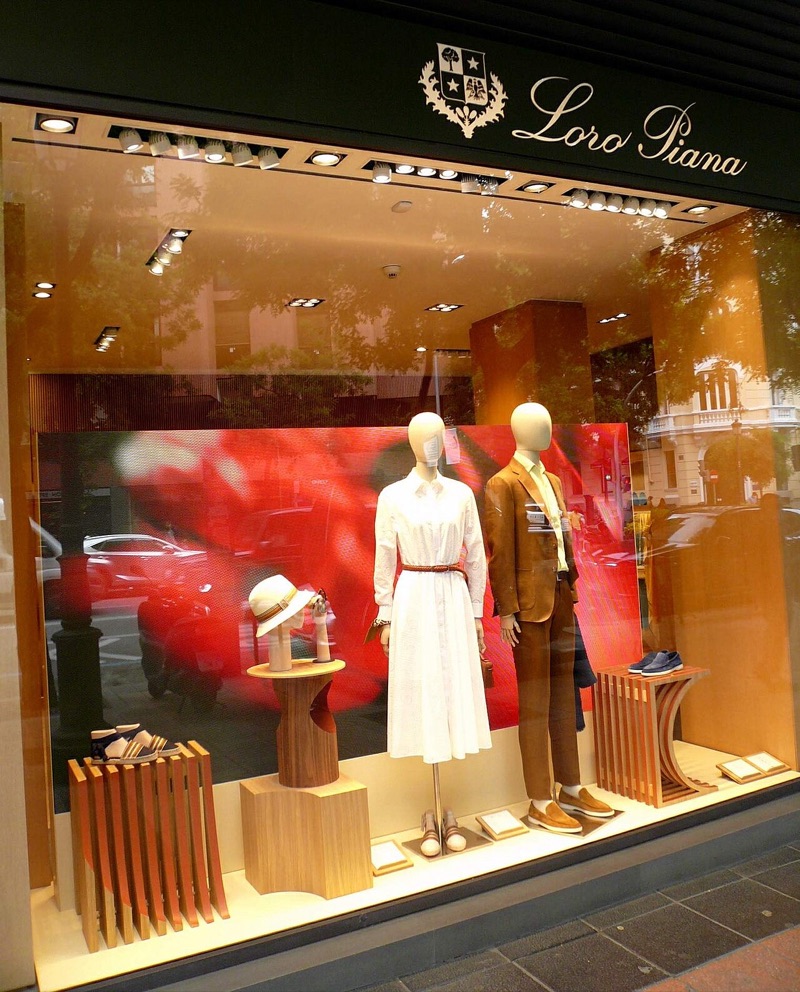
- Madrid - Loro Piana (Ortega y Gasset 16): Photograph · Zarateman · Wikimedia Commons · CC0