Pengrajin · Artisans
George Cleverley
Sixty years in the London shoe trade before he opened under his own name, and one last shape that outlived him.
Cleverley worked in London shoemaking from before the First World War and founded his own house in 1958. The elongated, gently squared chisel toe he developed is one of very few last shapes attributable to an individual, and it survived him because the lasts did.
The chisel
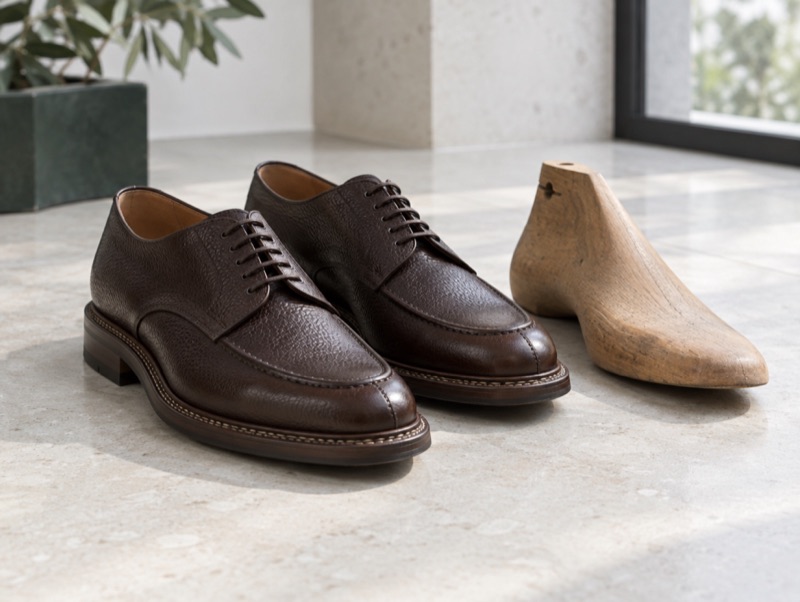
A long toe with a subtle square across the end, proportioned so the whole shoe reads as elongated rather than pointed. It is widely imitated and rarely equalled, because the shape only works if the rest of the last supports it: the waist, the instep and the heel all have to agree with it. It is a genuine design contribution in a trade where most shapes are inherited and anonymous.
How a shoemaker's legacy survives
Not through a name but through wood. Cleverley died in 1991 and the workshop continued under makers who had worked with him, using his lasts. That is how shoemaking transmits: the physical forms outlive the maker and carry the shapes forward. It is also why acquiring a shoemaking house means acquiring its last room, and why a maker's lasts are the most valuable thing in the building.
The trade he came out of
London bespoke shoemaking before the First World War was a substantial industry with a full apprenticeship system, several large houses, and specialists for every operation. Cleverley worked in it for four decades before setting up alone.
That depth of experience is the reason a house founded in 1958 carries a nineteenth-century pedigree, and it is also a measure of what has since been lost: nobody entering the trade today can accumulate that.
Sixty years before the name
Cleverley worked most of a career in other people's workshops before opening under his own name in later life, which was the ordinary route in a trade where the maker's name on the door was the exception rather than the ambition.
The last shape he developed is the durable part of the legacy, and it long outlived the shop's original ownership.
Sekilas pandang
Rumah mode yang bekerja dalam tradisi ini
Kredit foto 1
- An illustration of a welted shoe of the kind the house makes. Not a photograph of the house's own work.: Original art · Il Sartoriale · Il Sartoriale · Il Sartoriale original art