حرفي · Artisans
Ciro Paone
Ciro Paone founded Kiton in 1968, using top cloth and hundreds of trained tailors to make hand-tailored suits in volume without lowering quality.
Paone founded Kiton in 1968 on a merchant's premise: buy the best cloth available, employ enough trained tailors to make at volume, and refuse to compromise on either. The house now employs several hundred tailors at Arzano, owns a mill, and runs a school to train the makers it cannot otherwise find.
The bet
Conventional wisdom held that hand tailoring and volume were incompatible: a workshop of five could make by hand, a factory of five hundred could not. Paone's answer was to employ five hundred tailors rather than five hundred machine operators. That required solving a training problem the industry has never otherwise solved, which is why the house's school exists and why it matters more than it appears to.
The vertical move
Acquiring the Carlo Barbera mill gave the house a controlled cloth supply, an arrangement almost no other clothing brand has, and one that follows naturally from a founder who came from the cloth trade rather than from tailoring. The result is a business that can make claims about its supply chain that most competitors cannot substantiate, because it owns both ends of it.
The training problem
Every house in this trade faces the same constraint: hand tailors take years to train and almost nobody trains them. Most respond by competing for the tailors who already exist. Kiton's school responds by making more.
It is a small answer to a large problem (a school of this kind produces tens rather than thousands), but it is one of very few institutional responses anywhere, and it is the reason the house's claims about capacity are more credible than most.
A merchant's answer to a craft problem
Paone came from cloth, not from tailoring, and that is why the solution he arrived at was organisational rather than technical: if hand-tailoring cannot be mechanised, employ enough tailors, and if there are not enough tailors, train them.
The school is the part that will outlast the company. A trade that stops training ends, whatever its order book looks like.
في لمحة
دور الخياطة العاملة في هذا التقليد
حقوق الصور 1
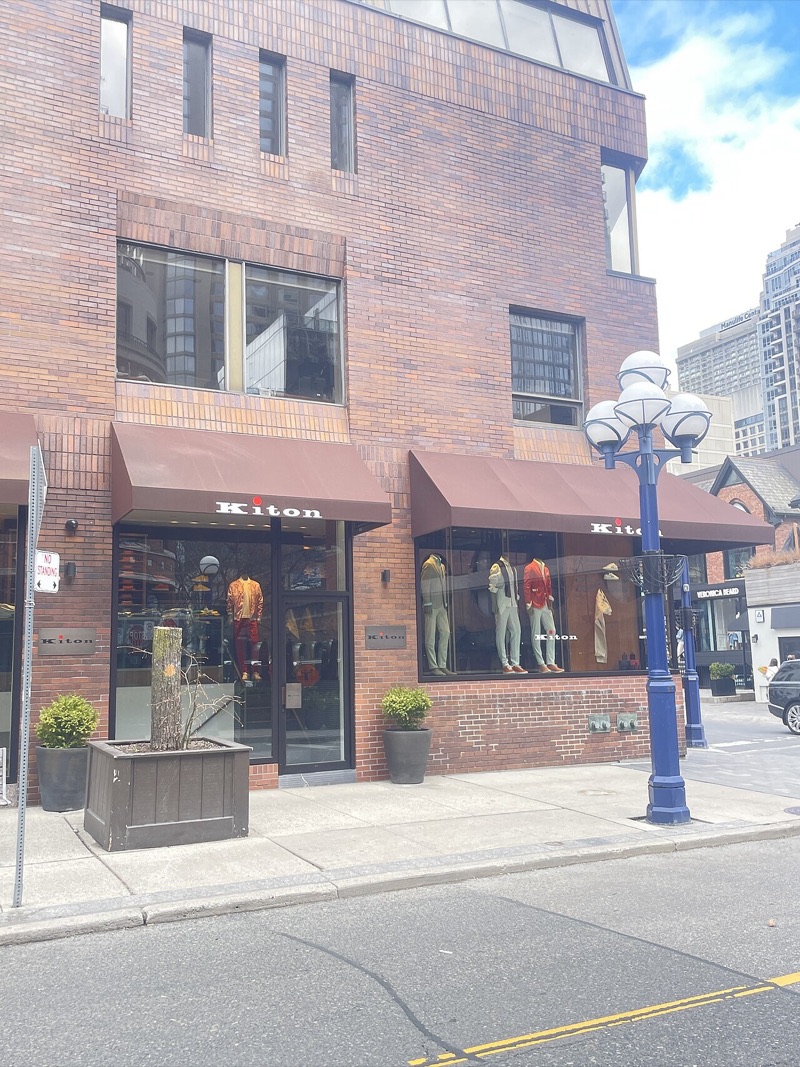
- IMG Kiton Toronto: Photograph · Shanmeichen · Wikimedia Commons · CC BY 4.0