Artigiano · Artisans
Gennaro Rubinacci
Gennaro Rubinacci was not a tailor but a cloth collector who opened London House in Naples in 1932 and hired Vincenzo Attolini to cut.
Rubinacci founded London House in Naples in 1932, selling English cloth and English style to a Neapolitan clientele. He was not a tailor; his contribution was taste, cloth and the judgement to employ Vincenzo Attolini and let him work. The house he founded still trades under his family's name.
The role he played
Rubinacci's contribution was curatorial rather than technical. He assembled cloth, set the aesthetic direction and built a clientele; the cutting was done by others. That is a real and under-credited role in tailoring, and the reason the house has a coherent identity across ninety years.
The cloth archive the house still holds, vintage lengths bought and kept, some of them decades old, descends directly from his collecting.
London House
The name was the proposition. In 1932 an English coat was what a well-dressed Neapolitan wanted, and Rubinacci sold English cloth, English shapes and an English idea of correctness to a city that had to wear them in Mediterranean heat.
What emerged from that tension is the whole Neapolitan tradition: the English coat, progressively disassembled until it worked locally. The shop's name is a record of where the style started rather than where it arrived.
Taste as a contribution
It is worth being precise about what a proprietor who does not cut actually contributes: cloth selection, aesthetic direction, the choice of who cuts, and the judgement to leave them alone. Those decisions determine a house's identity as much as any technique does.
The Rubinacci cloth archive, vintage lengths bought decades ago and kept, is the physical residue of that role, and it is close to unique in the trade.
The client who became the house
Rubinacci was not a tailor. He was a cloth dealer with an unusually developed eye who opened a shop, hired a gifted cutter, and directed what came out of the workroom: the role of an editor rather than a maker. That role barely exists in tailoring now and it mattered enormously then. Someone had to decide that the English coat should be dismantled, and it was not the person holding the shears.
In sintesi
Case che lavorano in questa tradizione
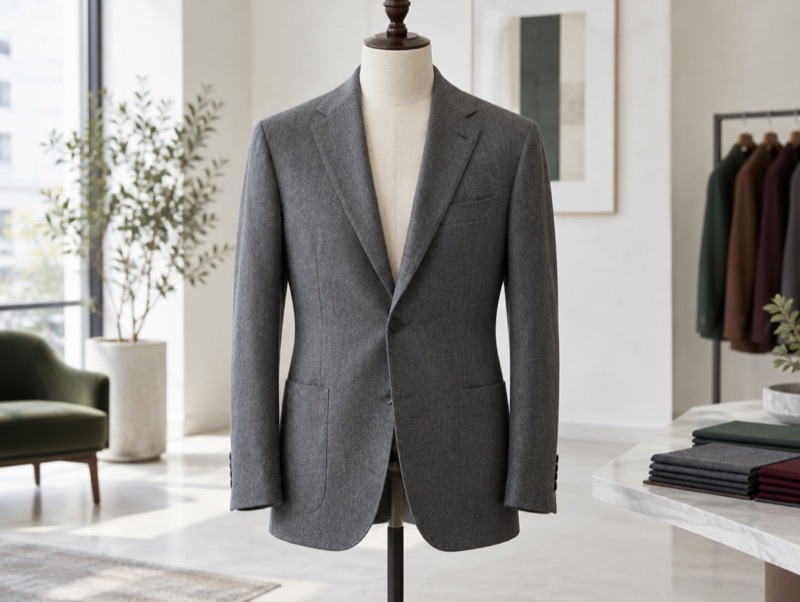
Crediti fotografici 1
- An illustration of the house's recorded cut: natural shoulder, light canvas chest, soft, short, open quarters. Not a photograph of the house's own work.: Original art · Il Sartoriale · Il Sartoriale · Il Sartoriale original art