Marque · Italy
Brioni
Brioni is a Rome tailoring house founded in 1945, known for staging what is called the first men's fashion show and for clean, firm-shouldered suits.
Brioni was founded in Rome in 1945 by Nazareno Fonticoli, a tailor, and Gaetano Savini, a businessman. It staged what is generally described as the first men's fashion show, built a reputation for a clean, structured Roman silhouette, and runs its own tailoring school at Penne in Abruzzo. It has been owned by Kering since 2012.
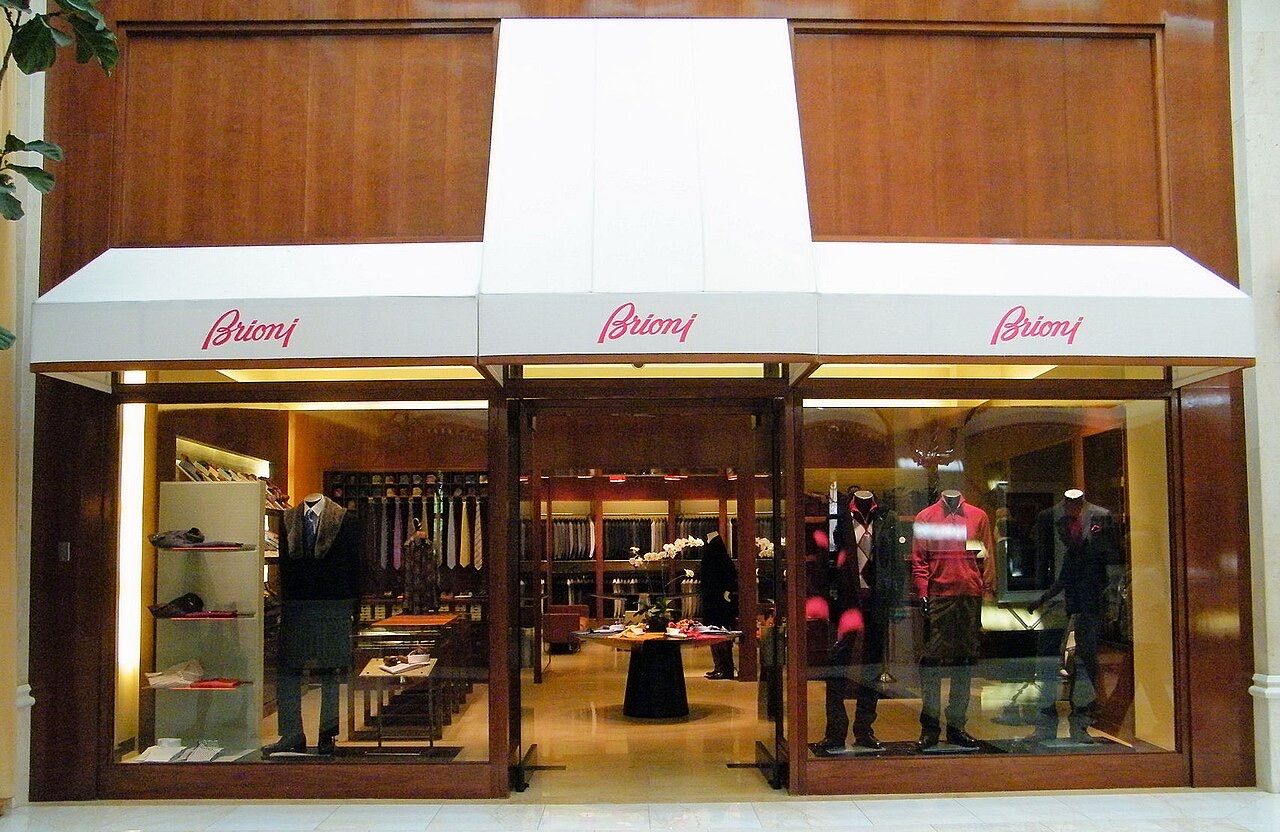
Founding and the show
Fonticoli was the tailor and Savini the commercial mind, and the house they founded in 1945 did something no men's tailor had done: in 1952 it presented a collection of men's clothing as a show at the Palazzo Pitti in Florence. It is conventionally described as the first men's fashion show, and the claim is at least defensible.
What followed was an international clientele and a house style (clean, structured, with a defined shoulder and a formal line) that became the Roman reference point.
Penne
Brioni's principal workshop is at Penne in Abruzzo, and the house has run a tailoring school there since the 1980s. The school takes several years to train a tailor and is one of the few institutional answers anywhere to the shortage of makers.
As with Kiton, the school is a real thing rather than a marketing device: an industry that needs hand tailors and cannot find them has to make its own.
Kering
Kering acquired Brioni in 2012. The house has had several creative directors since, with varying degrees of departure from the traditional line, and the ownership is a material fact about a brand whose appeal rests partly on continuity.
The tailoring at Penne continues. What group ownership changes is the pace of aesthetic direction and the breadth of the product range, both of which have moved considerably since 2012.
Sizing and fit
Roman rather than Neapolitan: a cleaner, more structured chest, a defined shoulder and a longer coat than the Naples houses cut. It accommodates a fuller figure considerably better and reads as more formal in a room.
As with any large house the range has moved with successive creative directors, and a Brioni suit from twenty years ago and one from today are recognisably different garments.
The house that invented menswear as spectacle
Brioni staged what is generally recorded as the first men's fashion show, in Florence in 1952, and the consequences run further than the event. Before it, men's tailoring was a private transaction between a customer and a cutter; presenting it as a collection created the modern category of designer menswear.
The Roman coat the house cuts is longer and cleaner than the Neapolitan one, with more structure and a quieter shoulder, and the tailoring school the house runs is a genuine institution rather than a marketing programme; it is one of the few reliable routes into the trade for someone with no family connection to it.
En un coup d'œil
Ce que cela coûte
Les prix sur le site →Ce ne sont pas des devis. Les prix indiqués ci-dessous sont les chiffres les plus récents que nous ayons pu attribuer à une source, présentés dans la devise de leur publication.
| Quoi | Service | Prix | Observé |
|---|---|---|---|
| Bespoke suitAn indicative band, not a quotation. Bespoke entry prices normally exclude tax and cloth beyond the house bunch, and houses raise them without announcement. | Sur mesure | €9,000–16,000 | September 2026 |
| Ready-to-wear suitAn indicative band, not a quotation. Bespoke entry prices normally exclude tax and cloth beyond the house bunch, and houses raise them without announcement. | Ready To Wear | €6,000–10,000 | September 2026 |
Comparé avec
Toutes les comparaisons →Sources
- Company information , Brioni.
- Kering acquisition of Brioni , Kering, 2012.
Lorsqu'un chiffre est contesté ou qu'une maison ne l'a pas publié, la page l'indique plutôt que de retenir un nombre.
Crédits photographiques 1
- Brioniboutique: Photograph · Coolcaesar · Wikimedia Commons · CC BY-SA 3.0